


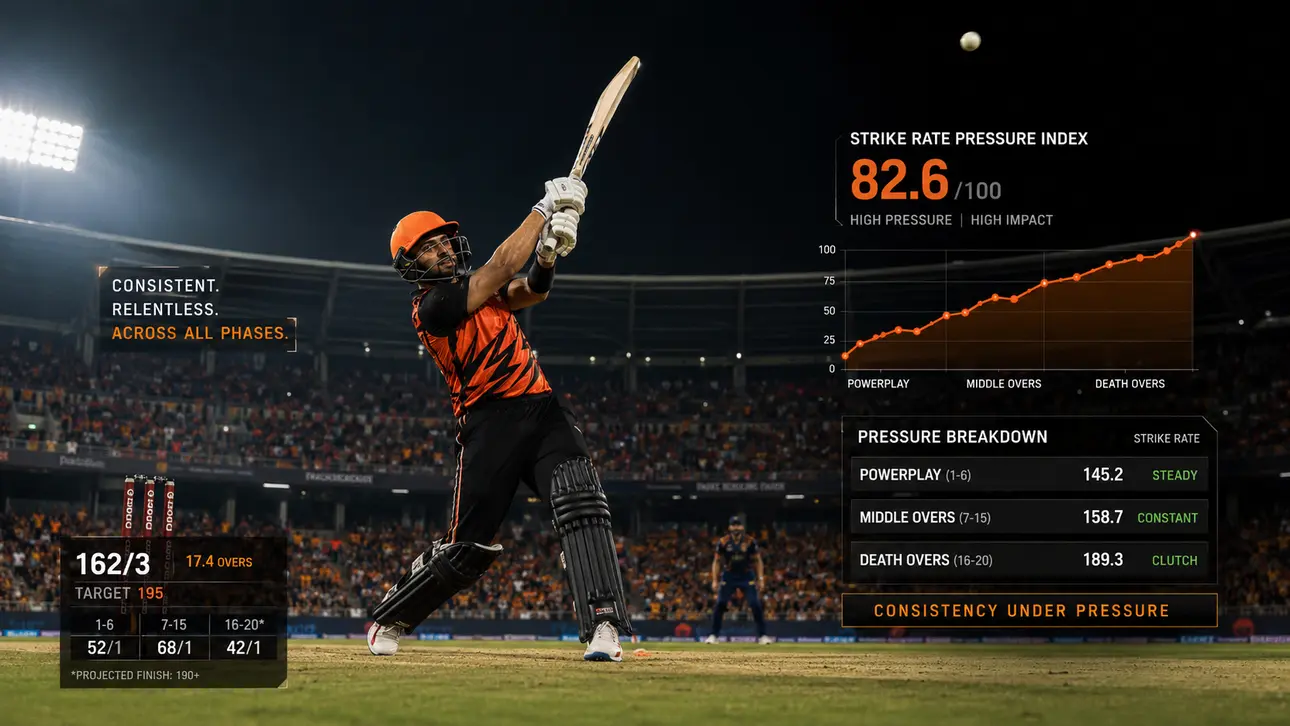
For years, IPL batters have mostly been judged. They have been judged by runs, average and strike rate. But IPL 2026 has shown these numbers do not always tell full story. A quick 40 runs under heavy pressure is far more valuable. Than the same score in an easy chase. Traditional stats do not show that difference.
That is where the Strike Rate Pressure Index becomes useful. It measures how valuable a batter really is in difficult match situations. It looks at things like required run rate. Also wickets left and bowling quality. It also checks how a batter performs when the pressure is highest.

This matters even more in IPL 2026. Chasing teams have dominated the season. SRPI helps separate true match-winners from players. The players who score mostly when the game is already comfortable.
Decoding the Strike Rate Pressure Index
The SRPI measures how valuable runs are under pressure. It does not just look at strike rate. It also checks the match situation when those runs were scored.
The system mainly looks at three things. First is the match phase. Runs in the death overs carry more value because scoring is harder against yorkers and slower balls. Middle overs also matter. Because spinners control the game there. Powerplay runs get a smaller boost because field restrictions help batters.
Second is the required run rate. If a batter comes in needing 12 runs per over. And still scores quickly, the SRPI rises sharply. If the chase is comfortable, the boost is smaller.
Third is wickets lost. Batting becomes harder when many wickets are already down. The pressure increases. Because the team cannot attack freely.
SRPI became important in IPL 2026. Because chasing teams dominated the season. Big totals became normal. Teams now want batters who can handle pressure, not just score fast in easy situations.
This metric helps franchises spot true finishers and clutch players. It also exposes batters whose strike rates look good. But only in low-pressure situations.
| Phase | Overs | Base Weight | Typical SRPI Adjustment Range |
| Powerplay | 1–6 | 0.20 | –10% to +15% |
| Middle Overs | 7–15 | 0.35 | –20% to +25% |
| Death Overs | 16–20 | 0.45 | –15% to +40% |
Powerplay Dominators Setting the Tone Early
IPL 2026 has changed the role of opening batters. Teams no longer want slow starts. The powerplay is now treated like an attacking phase from ball one. With teams scoring close to 10 runs per over early, aggressive openers have become match-winners.
The Strike Rate Pressure Index shows which batters are scoring quickly under real pressure. It gives extra value to runs scored when the required rate is high or wickets are falling.
Vaibhav Sooryavanshi has been the biggest powerplay force this season. The Rajasthan Royals opener scored 319 runs in the first six overs. He played at a strike rate above 245. His fearless hitting has put bowlers under pressure immediately. His SRPI is the highest among regular openers.
Priyansh Arya has done the same job for Punjab Kings. He attacks from the start and keeps the scoring rate high in almost every match. His strike rate in the powerplay is one of the best in the tournament.
Abhishek Sharma has led Sunrisers Hyderabad’s explosive starts. His attacking batting has helped SRH dominate high-scoring games. His SRPI stays high because he often bats in difficult chases with big required rates.
Josh Inglis has also impressed despite playing fewer matches. He attacks pace and spin equally well. His quick scoring has given Lucknow strong starts in pressure games. Travis Head has played a different role for SRH. He scores quickly but also keeps the innings stable.
Numbers show clear pattern in IPL 2026. Teams with explosive openers are winning more matches. Fast starts are no longer just bonus. They are becoming foundation for success.
Capitalizing on Hard New Balls
IPL 2026 has changed how batters play the new ball. Openers are no longer trying to settle in carefully. Most teams now attack from the very first over. Short boundaries and quick outfields have made this approach successful.
Powerplay scoring has reached around 10 runs per over this season. Teams crossing 60 runs in the first six overs are winning most matches. That has made explosive starts extremely valuable.
Priyansh Arya has been one of the biggest examples. His attacking batting for Punjab Kings helped produce huge powerplay totals, including a record stand against Delhi Capitals. He attacks hard lengths and uses the straight boundary well.
Vaibhav Sooryavanshi has done the same for Rajasthan Royals. His fearless hitting has turned the powerplay into a boundary-hitting phase instead of a settling phase.
Sunrisers Hyderabad have pushed this style even further. Abhishek Sharma and Travis Head regularly attacked from ball one. They have helped SRH post massive starts.
The Impact Player rule has also helped this trend. Batters now take more risks. Because teams have extra batting depth available later in the innings.
Surviving Early Swing and Seam
IPL 2026 has mostly favoured batters. But some venues still tested openers. The best batters were the ones who could adjust quickly. But instead of only attacking on flat pitches.
Josh Inglis showed this perfectly at Chepauk. The Chennai surface offered turn and uneven pace, but he still scored 85 off 33 balls. He used reverse sweeps to break the field. And avoid getting stuck against spin.
Finn Allen also handled difficult conditions well at Eden Gardens. The pitch offered early seam movement, but he still attacked in the powerplay. His aggressive style gave KKR fast starts. Although it also brought some early dismissals.
Abhishek Sharma showed another important skill. He kept the scoring rate high instead of slowing down. That helped SRH stay ahead in pressure chases.
Vaibhav Sooryavanshi has been the most complete powerplay batter this season. His strike rate has stayed high even against top fast bowlers and difficult new-ball spells.
The season has shown that true powerplay success is not only about hitting boundaries. It is about adapting to conditions. And still keeping pressure on the bowling side.
Middle Overs Controllers Navigating Spin and Variations
The middle overs have become one of the toughest phases. Spinners come into the attack. The field spreads out. Boundaries become harder to find. Batters who survive this phase with high scoring rate have become extremely valuable.
Rajat Patidar has been the best middle-overs batter this season. He attacks spin without taking wild risks. His strike rate in this phase is close to 200. He targets certain bowlers and clears the boundary regularly.
KL Rahul has also changed his approach. Batting in the middle order for Delhi Capitals has helped him attack spin earlier. He uses his feet well and finds gaps instead of getting stuck.
Heinrich Klaasen remains one of the best players of spin in the league. His sweeps and reverse sweeps have helped SRH keep scoring even when pitches slow down.
Sanju Samson has controlled the middle overs through clean hitting down the ground and strong shots through mid-wicket. Dhruv Jurel has played a different role for Rajasthan Royals. He rotates strike smartly and keeps pressure away from the batting side.
The best middle-overs batters are smart players who read bowlers early.
Death Overs Finishers Thriving Under Ultimate Pressure
The final overs decide most IPL matches. Teams need quick runs. They use wide lines to stop boundaries. In IPL 2026, the best finishers stayed calm. And still scored fast under pressure.
Heinrich Klaasen has been the standout batter in this phase. His strike rate in the death overs is above 200. He attacks all parts of the ground and handles pace well. Tim David and Rovman Powell have also finished games strongly with clean hitting.
Rinku Singh has impressed again with his calm approach in tense chases. Shashank Singh has become one of PBKS’s most reliable finishers with smart shot selection. The best finishers this season are not just power-hitters. They read the game well and pick the right balls to attack.
Deconstructing the Yorker and Wide Lines
Death-over batting in IPL 2026 has become a battle. Bowlers rely on yorkers and slower balls. And bouncers to stop boundaries. Batters have adjusted with smarter shot-making and better awareness.
Heinrich Klaasen has mastered the scoop against wide yorkers. Tim David attacks slower balls by waiting deep in the crease before pulling hard. Rovman Powell handles body-line bowling with strong pull shots to the leg side. Shashank Singh uses the inside-out drive against wide deliveries.
Rinku Singh stays calm under pressure. He focuses on smart placement instead of only swinging for sixes. The best finishers now mix boundaries with singles and twos. They know when to attack and when to stay patient. That balance has become the key to winning close IPL matches.
Comprehensive Analysis of the Top SRPI Batter
Heinrich Klaasen has been the best pressure batter. His numbers become even stronger when match situation is added into the analysis. He did not just score quickly on flat pitches. He scored when the asking rate was high and wickets were falling. That is why his SRPI score of 198.7 stands above every other batter this season.
Klaasen was dangerous in both the middle overs and death overs. Most batters dominate only one phase. Klaasen controlled both. His middle-overs strike rate of 168.4 helped SRH keep momentum against spin. His death-overs strike rate of 208.3 made him the most feared finisher in the league.
His innings against Mumbai Indians showed his value clearly. SRH were chasing 244 and the pressure was massive. Klaasen attacked even against bowlers like Jasprit Bumrah. He scored 51 off 24 balls and shifted the match completely.
He also adapted to different situations. Against Punjab Kings, he rebuilt the innings after early wickets. Against RCB, he attacked spin in the middle overs. Thenpushed SRH towards a huge total.
His season was not about empty runs. He delivered in hard chases and pressure moments. That is what made him the top SRPI batter of IPL 2026.
Performance Breakdown Strengths Weaknesses Opportunities Threats
Heinrich Klaasen has been the most complete pressure batter. His biggest strength is how his game improves when pressure rises. His SRPI rises sharply in the middle overs and death overs. That shows he performs best when matches become tense.
He can score all around the ground. He plays the scoop, reverse sweep, pull and lofted drive with equal confidence. Bowlers struggle to set fields against him because he has very few predictable patterns. He is also strong against both pace and spin.
Another major strength is his calmness. He rarely wastes balls in the death overs. He keeps the scoreboard moving even when the asking rate is high.
There are still a few weak areas. Fast bowlers who hit hard lengths outside off stump can slow him down early in the innings. Left-arm pacers who swing the new ball away from him have also troubled him sometimes.
Klaasen still has room to grow. A higher batting position could make him even more dangerous. Leadership roles may also come in the future.
The biggest threat is workload and fatigue. Teams may also start targeting him with more short slower balls in the playoffs.
Future Trends The Evolution of Evaluating Batters
Teams are now judging batters very differently in T20 cricket. Raw average and strike rate are no longer enough. Franchises now care more about when runs are scored. And how much pressure the batter handled. That is why advanced metrics like SRPI are becoming important.
Batters who perform in difficult situations now carry more value in auctions. A quick 35 in a tense chase matters more than an easy 50 on a flat pitch. Teams are also building players for specific phases. Explosive openers attack the powerplay. Smart batters control the middle overs. Finishers handle the death overs.
Data analysis is also becoming more advanced. Teams now study batter vs bowler matchups during games. In the future, AI and live data could help decide batting orders instantly. Heinrich Klaasen perfectly represents this new T20 era.
Final Words
This season has changed the way people judge T20 batters. Big run totals and fast strike rates still matter. But context matters more now. The Strike Rate Pressure Index has shown which batters truly perform when matches are under pressure.
Heinrich Klaasen has been the best example of that. He does not only score quickly. He scores quickly when the game is slipping away. Or when the required rate is climbing fast. That is what makes his SRPI so high.
Klaasen has dominated the death overs with smart shot selection. He attacks yorkers, slower balls and spin with equal confidence. He also adjusts his tempo based on the match situation.
IPL teams are now searching for batters who can handle pressure .And not just score runs. That is the biggest lesson from this season. In modern T20 cricket, the most valuable batter is the one who delivers when every ball matters most.
Craving deeper cricket insights? Follow Online Cricket ID today for your daily dose of expert tactical analysis, IPL 2026 breakdowns, and cricket updates that go way beyond the scorecard. (29 words)
