


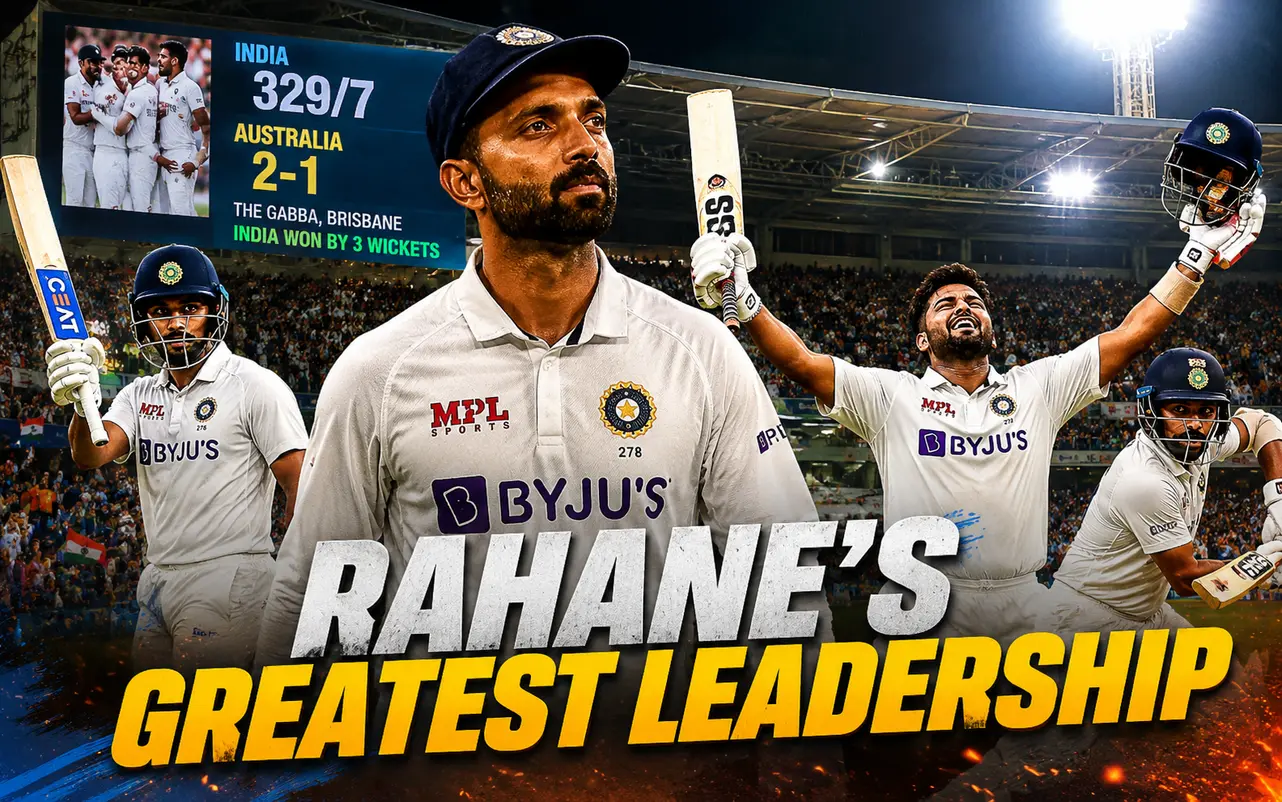
India were bowled out for 36 in Adelaide. Their captain Virat Kohli left after the first Test. Injuries and inexperience piled up against them. Australia had not lost at the Gabba since 1988. The odds could not have been worse. Yet India won the series 2-1. Ajinkya Rahane did not make the winning runs at the Gabba. But his leadership and Melbourne century set the tone for the comeback. This is why the series still defines his legacy.
Why Does The Gabba Win Define Rahane’s Legacy?
The Gabba result was the culmination of Rahane’s captaincy. It came after one of India’s lowest moments. It was not an isolated last-day victory. Rahane took charge when India were 0-1 down. He scripted a turnaround and helped the side bounce back. The series win is arguably India’s biggest victory outside the 1983 and 2011 World Cups.

What Made India’s Gabba Victory So Unlikely?
India chased 328 to win by three wickets. This was the highest successful fourth-innings chase at the Gabba. Australia had not lost a Test there since 1988. India were without several first-choice players because of injury or absence. The previous successful chase at the ground was 236 for 7 in 1951.
Why Was Rahane’s Role Bigger Than His Final-Test Score?
Rahane’s contribution was chiefly leadership. He created a composed environment after Adelaide. He backed emerging players fully. He kept India focused on a win even though a draw would have retained the trophy. He led by example with his calm demeanour and shrewd captaincy.
| Gabba Test metric | Result |
| Match | Fourth Test, Brisbane |
| Target for India | 328 |
| India’s result | 329 for 7 |
| Margin | India won by three wickets |
| Series result | India won 2-1 |
| Historic significance | Australia’s first Gabba Test defeat since 1988 |
How Did Rahane Respond After Adelaide’s 36 All Out?
Adelaide was the turning point. India collapsed to their lowest Test score of 36. Josh Hazlewood took 5 for 8 and Pat Cummins took 4 for 21. Rahane inherited captaincy after the first Test. He responded not through public drama, but through a substantial batting performance and a calm reset at Melbourne.
Why Was The Melbourne Century So Important?
Rahane made 112 in the Boxing Day Test at the MCG. This gave India the platform to level the series. He led from the front on a lively pitch against a fiery Australian attack. His innings gave India a 131-run first-innings lead. It was a captain’s response to the Adelaide collapse and the loss of Kohli for the rest of the tour.
How Did His Demeanour Help The Team Recover?
Rahane’s low-key leadership style was crucial. No flamboyancy, no cussing, no sledging. He won it with a smile that endeared him to both Australians and Indians. The team’s recovery from 36 all out to a series win showed a group that regained belief without abandoning its positive approach. As Rahane said: “It was not about me but about the team. I looked good because everyone contributed.”
How Did Rahane Manage An Injury-Hit Indian Squad?
The final Test included players with limited experience. Several regulars were unavailable through injuries. Rahane’s task was to give inexperienced players clarity and confidence.
Which Players Stepped Up During The Series?
Shubman Gill made 91 in the Gabba chase. Cheteshwar Pujara absorbed pressure with 56 from 211 balls. Rishabh Pant finished unbeaten on 89. Washington Sundar and Shardul Thakur set the benchmark with their batting. Mohammed Siraj took 5 for 73 in Australia’s second innings.
Why Was Backing Young Players So Crucial?
A captain in a depleted squad must give inexperienced players clarity and confidence. Rahane trusted young, rookie players like Pant, Gill, Siraj, Sundar, Saini, Thakur and Natarajan. India’s young and replacement players performed in decisive moments rather than merely filling places.
| Player | Gabba contribution | Leadership significance |
| Shubman Gill | 91 runs | Took India’s chase forward at the top |
| Cheteshwar Pujara | 56 off 211 balls | Absorbed pressure against Australia’s attack |
| Rishabh Pant | 89 not out | Finished the record chase |
| Washington Sundar | 22 off 29 balls | Supplied late attacking support |
| Ajinkya Rahane | 24 off 22 balls | Kept the chase positive as captain |
What Tactical Calls Showed Rahane’s Leadership?
Rahane’s captaincy was calm and composed. He was a thinker in the MS Dhoni mould who marshalled his depleting resources magnificently. His bowling changes and field settings were shrewd.
What Did Rahane Tell Rishabh Pant During The Chase?
Rahane later said he told Pant to see out the final 15 minutes before tea. He even suggested Pant could lie down if needed. The instruction showed an awareness that Pant’s match-winning aggression needed to be balanced with the immediate match situation. During tea, India sent messages to Pant but he was always looking to chase the total. Credit to him, he took that risk and took on the Aussies.
Why Did India Choose To Chase Victory?
A draw would have been enough for India to retain the Border-Gavaskar Trophy. But the team pursued 328. India’s final-day scoring, including 51 runs in the last five overs, showed an intent to win rather than simply survive. Rahane signalled their intent with 24 off only 22 balls. The team wanted to play simple cricket and fight hard session by session.
Why Was The Gabba Record Chase So Historic?
The match had enormous historical scale. India’s win ended one of the most imposing home records in modern cricket.
What Record Did India Break At The Gabba?
India’s 329 for 7 was the highest successful fourth-innings chase in a Gabba Test. The previous successful chase at the venue was 236 for 7 by Australia against the West Indies in 1951.
How Long Had Australia Been Unbeaten There?
Australia had not lost a Test at the Gabba for 32 years, since 1988. India’s win was their first Test victory at the venue. The Gabba was no longer such a “stronghold” for Australia.
How Strong Was Rahane’s Captaincy Record?
Rahane had an undefeated Test captaincy record. He led India in six Tests, winning four and drawing two. He has the highest win percentage for an Indian Test captain with at least five matches.
What Was Rahane’s Record As Test Captain?
Rahane led India in six Test matches. He won four games and drew two. He never lost a Test as captain. India lost only one match under his captaincy across all formats.
Why Does The Australia Series Carry More Weight?
A leadership legacy is not only about win percentage. The Australia series involved away conditions, a historically difficult venue, injury disruptions and a side rebuilding after a severe first-Test defeat. Rahane led India to a 2-1 Border-Gavaskar Trophy win after taking over as stand-in captain following the first Test.
What Did The Gabba Win Mean For Indian Test Cricket?
The victory strengthened India’s reputation as an elite away Test team. It confirmed the value of squad depth. It secured India’s second consecutive Test-series victory in Australia and their third successive Border-Gavaskar Trophy series win.
How Did It Change India’s Reputation Overseas?
India’s success made it two consecutive Test-series wins in Australia. This made the result more than a one-off upset. The depth of Indian cricket was described as “scary” by AB de Villiers.
Why Does The Victory Still Resonate With Fans?
The match remains powerful because its heroes were varied: a stand-in captain, young opener, injured and resilient senior batter, wicketkeeper-finisher, replacement bowlers and debutants. The result represents collective resilience rather than a single-player triumph. “It was about having that character on the field, having the fighting spirit, the attitude,” said Rahane.
Why Should Rahane Be Remembered As The Leader Of Gabba 2021?
Rahane was neither the sole architect of the victory nor the leading run-scorer at the Gabba. But his leadership supplied the stable framework in which the team’s contributors could thrive.
Was Rahane The Match-Winner At The Gabba?
Pant, Gill, Pujara and the bowling unit were decisive in the final Test. Rahane’s place in the story comes from captaining the turnaround, setting its tone with a century in Melbourne, and guiding an injury-hit side through the series. He won the match and India, the series. He has an enviable scorecard as captain.
What Is The Lasting Image Of His Leadership?
The enduring image is not of a captain seeking attention. It is of one who helped a battered team believe that a historic win was still possible. Rahane, fittingly, means invincible. Captaincy was not meant to be his. But the mantle fell on his shoulders and he rose to the occasion.
Conclusion
Rahane’s Gabba legacy rests on the series arc: 36 all out in Adelaide, a restorative 112 at the MCG, and a depleted India chasing 328 to beat Australia by three wickets in Brisbane. The final-day heroes made the runs. But Rahane’s calm, positive leadership was the thread connecting India’s recovery to one of its greatest overseas Test victories. “A series we can never forget,” he said. That series will forever define his legacy.
Stay updated with more iconic cricket stories, player insights, and match analysis. Follow Online Cricket ID for daily cricket news, exclusive features, and the biggest moments from around the world.
