


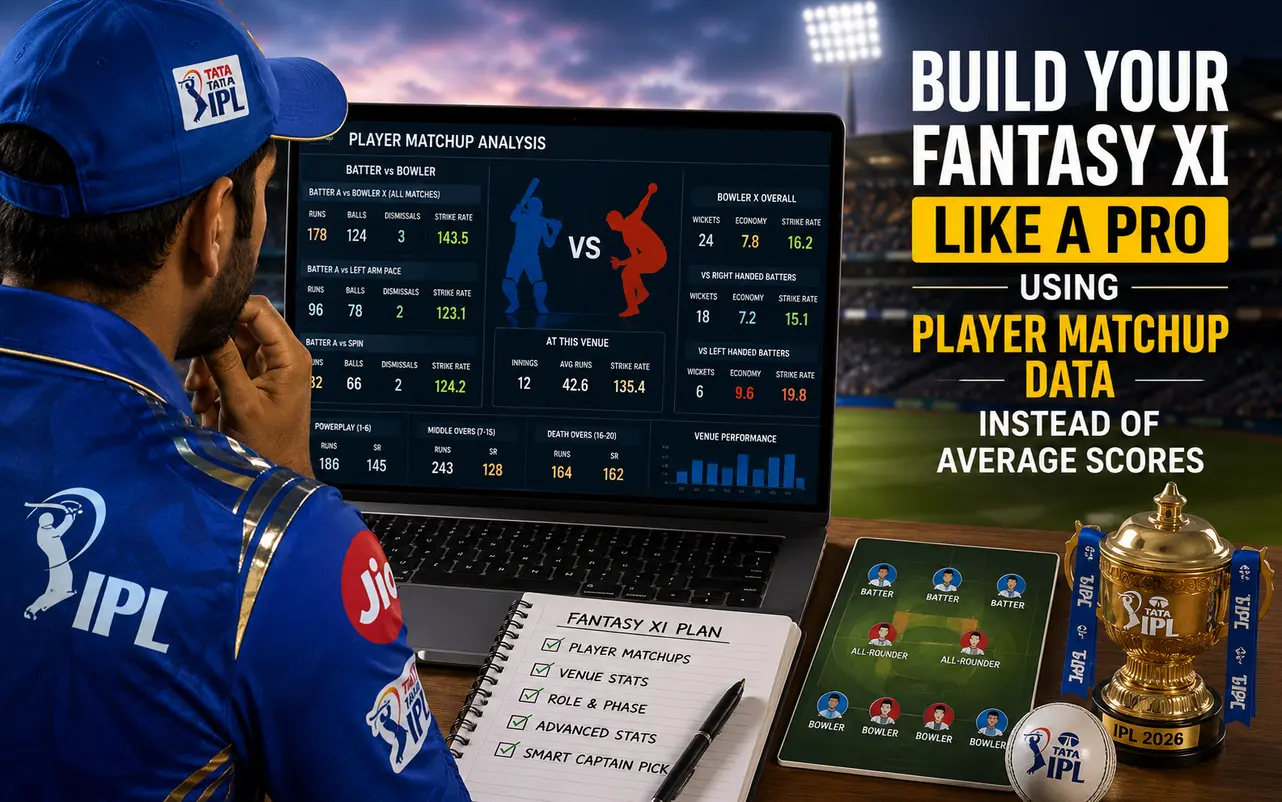
Most fantasy cricket players make the same mistake. They pick players based on who scored the most points in the last match or who has the best average over the last five games. That is a lazy way to build a team. Serious players look at something else. They look at matchup data. A batter might average 50 runs overall, but against a specific bowler or on a specific pitch, that number drops to 20. A bowler might have a great economy rate, but against a left-handed opener, he gets hit for 12 runs an over.
This article will show you how to use advanced stats and IPL 2026 data. You will learn to build smarter fantasy XIs. These teams will be situation-aware. You won’t rely on raw averages.

Why Average Scores Mislead Your Fantasy Cricket Decisions
Raw fantasy points are often useless. Five-match averages can mislead you too. They ignore the context of each game. A player might have scored big. But he might have faced a weak bowling attack. Or he might have played on a flat pitch. He might have moved up the batting order for one game because someone was injured. The next game, he is back at number six. His average looks good, but his role has changed.
Averages also hide small sample sizes. A player might have had two good games in a row. That does not mean he is suddenly a world-beater. It could be a hot streak. Fantasy players who chase recent scores end up picking players who are due for a failure. Matchup data gives you a clearer picture of what to expect.
Common Mistakes Fantasy Players Make With Averages
Chasing last match heroes is the biggest trap. A player scores a century, and everyone picks him the next game. But he might be facing a bowler who has dismissed him five times in the past. Or the pitch might be completely different. Picking a batter who scored big on a flat track to play on a turning pitch is a recipe for failure.
Another mistake is ignoring role changes. A player might have scored 50 runs batting at number three. But in the next game, he is batting at number six. Because the team wants to try someone else at the top. His scoring potential drops significantly. Captaining a player just because he scored a century recently is also risky. You need to look at who he is facing and where he is playing. Context matters more than recent points.
How Player Matchup Data Works In T20 And Fantasy
Matchup data is simple. It looks at how a batter performs against specific types of bowling. Does he struggle against left-arm pace? Does he dominate leg-spin? It also looks at how a bowler performs against specific types of batting. Does he take wickets against right-handers but get smashed by left-handers? Does he bowl well in the powerplay but get expensive at the death?
Venue data is also part of the picture. Some grounds are small and favour batters. Others are large and help spinners. Some pitches offer swing early on. Others are flat from the first ball. Phase-wise data is equally important. How does a batter perform in the powerplay versus the middle overs versus the death overs? A player might be a powerplay specialist but struggle to score when the field spreads out. All of this information helps you make better decisions.
Key Matchup Metrics Fantasy Players Should Track
There are four core metrics that actually help with fantasy decisions. The first is a batter’s strike rate and dismissal rate against left-arm pace versus right-arm pace. Some batters can handle pace but struggle against spin. The second is a bowler’s economy rate and wicket-taking ability against left-handers versus right-handers. A bowler might be a wicket-taking machine against right-handers but get hit for runs by left-handers.
The third metric is venue-specific performance. How many runs does a batter score at this ground? What is a bowler’s average at this venue? The fourth is phase-wise performance. How does a batter perform in the powerplay? How does a bowler perform at the death? These numbers give you a much clearer picture than a simple overall average.
| Batter | Vs Pace (Runs) | Vs Pace (SR) | Vs Spin (Runs) | Vs Spin (SR) | Dismissals |
| Player A | 450 | 145 | 280 | 120 | 12 |
| Player B | 320 | 130 | 410 | 150 | 8 |
Player A dominates pace but struggles against spin. Player B is the opposite.
Using IPL Data Analysis 2026 To Pick Smarter Fantasy XIs
The IPL 2026 season gives us a lot of useful data. It helps us understand player roles and matchups. The tournament has 74 matches. Every player has a clear role. You can see exactly where a batter bats. You can see how many overs a bowler bowls. You can also see who they perform well against. This data is gold for fantasy cricket team prediction.
Reading Player Roles From IPL 2026 Usage
Do not just look at total runs or wickets. Look at how a player is used. A batter who opens the batting every game is more valuable than a batter who floats between number three and number six. A bowler who bowls four overs every game is more valuable than a bowler who only bowls two. Role stability often matters more than total output when projecting fantasy output.
Check the scorecards. See where a player bats. See when a bowler bowls. If a player is used in the powerplay and the death, he has more opportunities to score points. If a batter is used as a finisher, he might only face ten balls a game. That limits his ceiling. Role clarity is everything.
Spotting Hidden Value From Advanced IPL Stats
Look for players who are undervalued. A bowler with a high dot-ball percentage is a good pick. He may not take many wickets. But dot balls earn points in most fantasy formats. A batter with a high boundary percentage is also valuable. He scores quickly and earns bonus points. Impact overs are another key metric. A bowler who bowls in the death overs has more chances to take wickets. A batter who bats in the middle overs has more time to score runs.
Advanced IPL Metrics To Track
- Dot ball percentage for bowlers
- Boundary percentage for batters
- Impact overs bowled (powerplay and death)
- Batting position stability
- Economy rate against specific batting types
Building A Matchup First Fantasy XI Step By Step
Building a fantasy XI using matchup data is a process. It is not about picking the biggest names. It is about picking the right players for this specific game.
Step One Analyse Fixture Pitch And Conditions
Start with the venue. What is the average first innings score? Does the pitch favour spin or pace? What is the chasing success rate? Some grounds are batting paradises. Others are bowling-friendly. This information tells you what type of players to prioritise. If the pitch favours spin, pick spinners. If it is a batting track, pick batters. Do this before you even look at player names.
Step Two Lock Core Matchup Favourable Options
Shortlist four to six players whose matchup numbers strongly favour them in this game. A batter with a strong record against the opposition spinners is a good pick. A pacer with wickets against the opposition top order is another. Use these players as your captaincy or vice-captaincy candidates. These are the players most likely to deliver big points.
Step Three Fill Roles With Ceiling And Floor In Mind
Once you have your core matchup players, fill the rest of your team with a balance of safe picks and high-ceiling punts. Openers and four-over bowlers are usually safe picks. They have guaranteed time in the middle. Finishers and death bowlers are high-ceiling punts. They might only get a few balls or a couple of overs, but they can score big points quickly.
| Player | Role | Matchup Edge | Risk Level |
| Player A | Opener | Strong vs pace | Safe |
| Player B | Opener | Strong vs spin | Safe |
| Player C | Middle Order | Good vs left-arm | Medium |
| Player D | Finisher | Death overs hitter | High (Punt) |
| Player E | Pace Bowler | Powerplay wickets | Safe |
| Player F | Spinner | Middle overs control | Safe |
| Player G | Death Bowler | Yorkers at the death | High (Punt) |
Case Study Using Matchup Data For One Sample Fixture
Let us walk through a hypothetical T20 fixture. We will use IPL 2026 data to show how matchup data changes player choices compared with picking purely on average fantasy points.
How A Casual XI Differs From A Matchup Driven XI
The casual player picks the top five run-scorers in the tournament. He picks the top three wicket-takers. He ignores the pitch, the opposition, and the matchups. The matchup-driven player looks at the venue. He sees that the pitch favours spin. He picks spinners. He looks at the opposition batting lineup. He sees they struggle against left-arm spin. He picks a left-arm spinner. He looks at the opening bowlers. He sees one bowler has a great record against the opposition openers. He picks that bowler.
The casual XI might look good on paper. But the matchup XI has players who are specifically suited to this game. They are more likely to perform.
Lessons From The Case Study For Everyday Fantasy Players
The key lesson is simple. Do your research before every game. Do not just pick the same players every time. Look at the pitch. Look at the opposition. Look at the matchups. This process takes time, but it pays off. Consistency is more important than occasional big wins. A disciplined approach will give you an edge over the long term.
Strengths Weaknesses Opportunities Threats Of A Matchup First Fantasy Approach
A matchup-first strategy is powerful, but it has limitations.
Strengths And Weaknesses Of Relying On Matchups
The strength is context. You are not guessing. You are making informed decisions based on data. This gives you a sharper captaincy decision and a more balanced team. The weakness is overconfidence. Matchup data is not perfect. Small sample sizes can mislead you. A batter might have a great record against a bowler, but that record might be based on only three or four innings. That is not enough data to be sure. Intangibles like niggles or role changes can also throw off your predictions.
Opportunities And Threats In A Data Saturated Fantasy Market
The opportunity is that most players still ignore matchup data. You can gain an edge by using it. The threat is that as more people use the same data, the edge shrinks. When everyone chases the same matchup picks, contest variance increases. The key is to use data as a guide, not as a guarantee. Combine it with your own cricket knowledge.
Practical Tips To Start Using Matchup Data From Today
You do not need a data science degree to use matchup data. Here are five concrete steps you can implement immediately.
Simple Checklist Before Locking Any Fantasy XI
Before you lock your team, run through this checklist. Confirm the playing XI. Check the batting order. Check the bowling quota. Check the pitch type. Check the key matchups. Check your captaincy options. Do this quickly but consistently before every contest. It takes five minutes and will dramatically improve your results.
- Confirm the playing XI
- Check batting positions
- Check bowling quotas
- Check pitch conditions
- Check key player matchups
- Choose captain and vice-captain based on matchups
Conclusion
The biggest difference between casual and pro-style fantasy players is not luck. It is process. Casual players chase points. Pro players chase matchups. Using matchup data makes every selection more intentional. It improves your decision quality over a season. It turns IPL 2026 and other leagues into rich datasets rather than just entertainment. Start with one or two matchup metrics. Build your routine gradually. Over time, you will see the difference. Your fantasy XI will be smarter, more balanced, and more likely to win.
Stay ahead of the game with expert cricket insights, IPL analysis, fantasy tips, and match predictions. Follow Online Cricket ID for fresh, in-depth cricket articles and updates every single day.
