


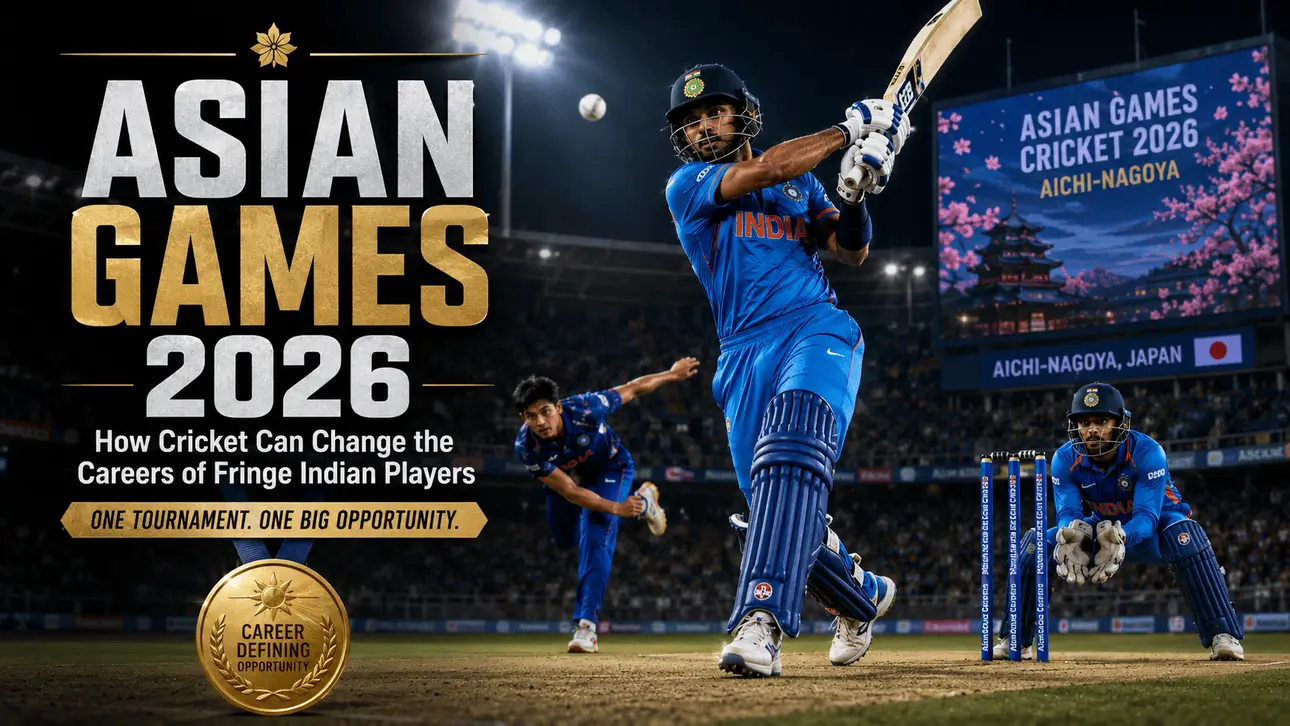
The Asian Games 2026 are coming up fast. Japan is hosting the event in Aichi-Nagoya from September 19 to October 4. And here’s the catch – India are also hosting West Indies for a full white-ball series at the exact same time (September 27 to October 17).
That means the BCCI has to prepare two completely separate T20 squads. One will face the Windies at home. The other will travel to Japan. This is where the fringe players, the bench strength, and the uncapped stars get their shot. For them, this tournament is not just about winning a medal – it’s about proving they belong at the highest level. The BCCI has already submitted a 30-man probables list for the Asian Games, and the full squad is expected to be named soon.

Why Asian Games 2026 Cricket Matters for Rising Stars
Playing cricket at a multi-sport event is different from a normal bilateral series. The pressure is real. You are not just representing your state or franchise; you are representing the entire country in front of a global audience.
For young players who have never been part of an ICC event, this is their first taste of that unique pressure – the packed stadiums, the anthem ceremonies, the medal matches. And the stakes are high: India have already won gold in the previous edition (Hangzhou 2023) under Ruturaj Gaikwad, and the expectation will be to defend that title.
A medal here is not a consolation – it is a career accelerator. A strong performance in Japan will push a fringe player straight into the T20I core, ahead of the 2028 Olympics where cricket will return after 128 years. That is the kind of exposure that can fast‑track a career.
Defining Fringe Indian Players in the Current Setup
Let’s be clear about who we are talking about. India’s T20I team is crowded. The first-choice XI – Suryakumar Yadav, Hardik Pandya, Arshdeep Singh, Ravi Bishnoi – are almost impossible to displace right now. The “fringe” players are the ones who have been knocking on the door without getting a consistent run.
They are the bench strength – players who have been part of India ‘A’ tours, who have topped domestic charts, but have only one or two international caps to their name. Some have even made their debut but were dropped immediately after. The Asian Games is where these players can finally earn a longer rope. The BCCI knows this. That’s why the 30-man probables list for the Asian Games is filled with such names – players who are not yet cemented in the main XI but are too good to ignore.
Standout IPL Performers Waiting for Consistent Chances
The IPL 2026 season has already thrown up several young names who are now knocking on the selectors’ door. The biggest example is Vaibhav Sooryavanshi. The 15-year-old sensation scored 776 runs for Rajasthan Royals at a strike rate of 237.30, winning the Orange Cap, and was immediately named in the 30‑probable list for the Asian Games.
Other IPL performers include Abhishek Sharma, who has been in red-hot form, and Nitish Kumar Reddy, whose all-round abilities have caught everyone’s eye. But a strong IPL does not automatically guarantee a senior India cap. That’s where the Asian Games steps in. A match‑winning knock in Nagoya will do what 1000 IPL runs cannot – force the selectors to pick you for the next T20I series.
- Vaibhav Sooryavanshi: 776 runs at 48.50 average, strike rate 237.31 (IPL 2026)
- Abhishek Sharma: 563 runs at strike rate 204.73
- Dhruv Jurel: 515 runs at 154.65 strike rate as wicketkeeper‑batter
Domestic Giants Seeking International Recognition
While IPL is the flashy ticket, domestic tournaments like the Syed Mushtaq Ali Trophy and Vijay Hazare Trophy are the real grind. Players like Abhimanyu Easwaran and Ruturaj Gaikwad have piled up runs for years in first‑class cricket but have struggled to get a long run in the T20I side.
Gaikwad, who captained India to gold at the Hangzhou 2023 Asian Games, is again in the probables list. For domestic giants, the Asian Games is the perfect platform – the format is T20, the opposition is strong, and the stage is big. If they can perform here, the “domestic bully” tag will finally disappear.
Evaluating Player Dynamics and Roster Competition
Let’s break down the player profiles without using complicated jargon. Every fringe player in the Asian Games squad has a set of core skills, some clear weaknesses, a massive opportunity in front of them, and a few threats that could derail their progress.
Core Advantages
- Batting Firepower: Players like Abhishek Sharma and Vaibhav Sooryavanshi can clear the boundary at will. Their power‑hitting is at par with international standards.
- Bowling Depth: All‑rounders like Nitish Kumar Reddy and Shivam Dube give the captain multiple options. In T20s, having six bowling options is a luxury.
- Athletic Fielding: The new crop is fitter and faster. In a format where runs are precious, saving 10‑15 runs in the field is as good as hitting a six.
Known Vulnerabilities
- Inconsistent Finishing: Some fringe batters have a habit of throwing away their wickets after getting a start. The pressure of a close chase often exposes this flaw.
- Death‑Over Inexperience: Bowling the 18th, 19th, and 20th overs requires a different skill set. Many young pacers have been hit for big runs because they don’t have a reliable yorker.
Massive Opportunities
- Gaining a Senior Cap: For uncapped players like Harshit Rana, a single appearance in Japan could open the door for IPL contracts and long‑term A‑tours.
- Becoming a Permanent Backup: With the 2027 ODI World Cup and 2028 Olympics coming up, the BCCI is building a pool of 30‑35 players. A good Asian Games performance will lock you into that pool for the next two years.
External Threats
- Injury Before the Tournament: The schedule is packed. A pulled hamstring or a back spasm can end a dream before it starts.
- Stiff Competition: There are only 15 spots in the final squad. For every player who gets selected, two others will be left behind. That level of competition can cause burnout even before the tournament begins.
Projecting the India Squad Asian Games 2026
The BCCI has not yet announced the final 15, but based on the 30‑probable list and recent selection patterns, we can make an educated guess.
Probable Squad for Asian Games 2026
| Player | Primary Role | Key IPL 2026 Stat |
| Shreyas Iyer | Captain / Middle‑Order Batter | 451 runs, strike rate 158 |
| Tilak Varma | Vice‑Captain / Batter | 385 runs, strike rate 149 |
| Sanju Samson | Wicketkeeper‑Batter / Opener | 477 runs, strike rate 165 |
| Abhishek Sharma | Opener / Left‑arm Spin | 563 runs, strike rate 204 |
| Ishan Kishan | Wicketkeeper‑Batter / Opener | 412 runs, strike rate 152 |
| Rinku Singh | Finisher | 295 runs, strike rate 171 |
| Nitish Kumar Reddy | All‑rounder (medium pace) | 312 runs + 12 wickets |
| Shivam Dube | All‑rounder (medium pace) | 288 runs + 8 wickets |
| Axar Patel | Spin All‑rounder | Economy rate 7.2, 14 wickets |
| Washington Sundar | Spin All‑rounder | Economy rate 7.5 |
| Varun Chakravarthy | Mystery Spinner | 16 wickets, economy 7.1 |
| Ravi Bishnoi | Leg‑spinner | 12 wickets, economy 6.9 |
| Harshit Rana | Fast Bowler | 15 wickets, average 19.8 |
| Arshdeep Singh | Left‑arm Fast | 14 wickets, economy 8.1 |
| Wildcard | – | – |
| Vaibhav Sooryavanshi | Opener | 776 runs, strike rate 237 |
Captaincy and Leadership
Shreyas Iyer has emerged as the frontrunner to lead the Asian Games squad. He has captained in the IPL and has experience handling pressure. Tilak Varma is expected to be his deputy. Jasprit Bumrah’s name is also in the probables list, but given his importance for the 2027 World Cup, he may be rested for the West Indies series instead.
The Direct Link From Nagoya to Future World Cups
The Asian Games might not be an ICC event, but it is a rehearsal for the big stage. Cricket will be part of the 2028 Los Angeles Olympics after a 128‑year gap. The format will be T20. The pressure will be immense.
The BCCI is already treating the 2026 Asian Games as a preparatory camp for LA 2028. Anyone who performs in Japan is essentially sending a message: “I can handle the big occasion.” The direct line from Nagoya to the 2028 Olympics is not an exaggeration – it is the selection committee’s current thought process.
Conclusion The Ultimate Stepping Stone
The 2026 Asian Games is more than a medal event. It is a filter. It separates the players who thrive under pressure from those who freeze. For the fringe players – the IPL stars without India caps, the domestic giants with only one or two outings – this tournament is their best shot at a permanent senior team spot.
A gold medal here will guarantee them a place in the BCCI’s central plans for the next two years. A failure will send them back to the grind of domestic cricket with no guarantees. The good news is that India have a deep pool of talent. The bad news is that only 15 can go to Japan, and only a handful will return as stars. But for those who make it count, the Asian Games won’t just be a tournament – it will be the moment their international careers truly began.
Crave more deep dives like this? Follow Online Cricket ID today for your daily dose of expert match analysis, breaking news, and exclusive insights into the cricketing world!
