


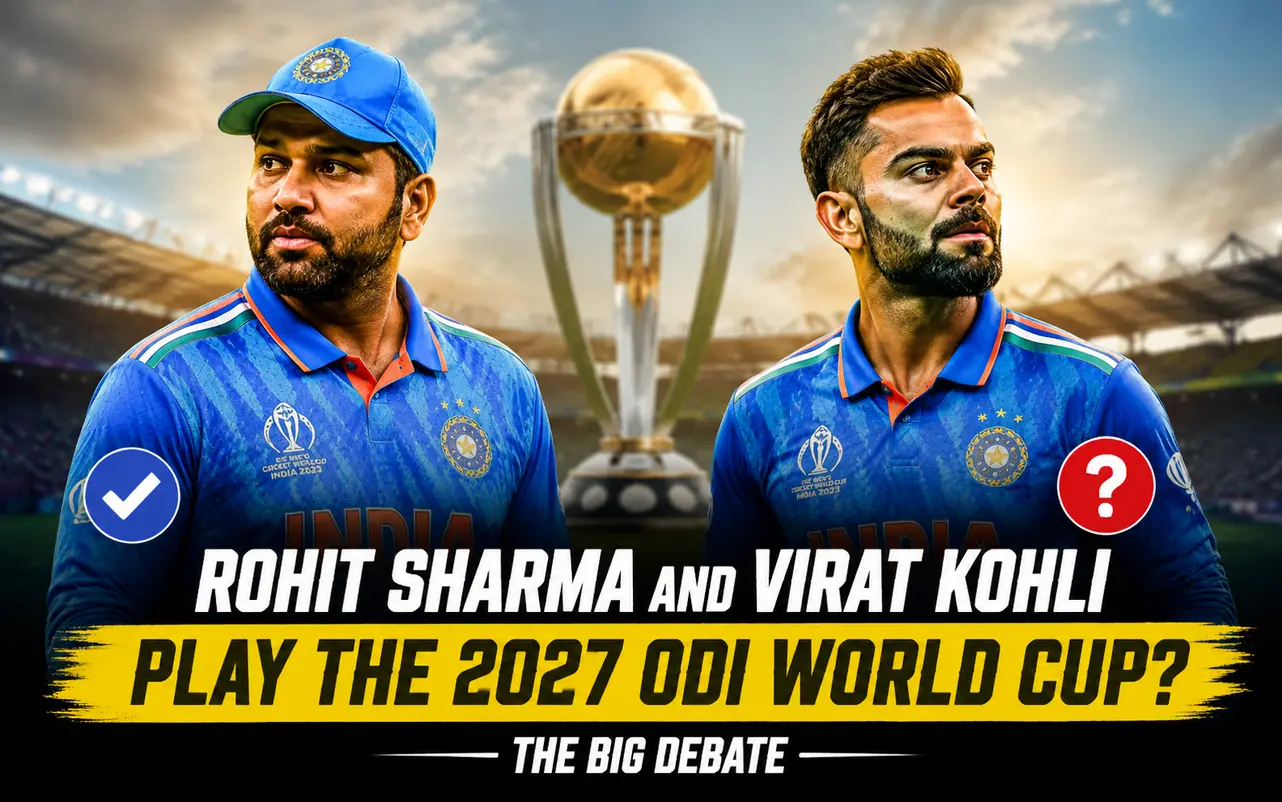
The question is everywhere. Should Rohit Sharma and Virat Kohli play the 2027 ODI World Cup? Social media is buzzing. Former players are divided. Reports suggest the selectors have told Rohit he is not in their plans for the tournament. Other reports say the BCCI has dismissed this and Rohit remains firmly in the team’s plans.
Shubman Gill has confirmed that Kohli is “absolutely” in the frame for the 2027 World Cup and that they are actively discussing team combinations together. This is more than a fan debate. India’s next World Cup cycle depends on whether the side builds around experience, youth, or a carefully managed mix of both. Here is a balanced look at the case for and against both players.

Why Worldcup 2027 Matters For Indian Cricket?
Is This About Sentiment Or Selection Logic
World Cup selection must be driven by form, role clarity, fitness, and match impact. Reputation alone should not guarantee a spot. The 2027 tournament will be played in South Africa, Zimbabwe, and Namibia. The pitches will be bouncy and conditions will be different from what India are used to at home.
Selection must be merit-based, not emotion-based. Mohammed Kaif, a former India batter, has drawn a parallel with Lionel Messi to argue that experience matters. He pointed out that Messi is 39 and his team reached the FIFA World Cup final. Messi did not score in the semi-final but provided an assist. “That’s what experience brings,” Kaif said.
Why Does The Transition Window Feel So Tight
The ODI schedule and World Cup timeline are forcing India to decide soon. Gautam Gambhir has said that India wanted a 2027 World Cup blueprint ready after IPL 2026. By the time IPL 2026 ends, India will have a blueprint for the ODI World Cup 2027. The team plays another 20 ODIs until early January 2027. Delayed decisions can create uncertainty for both seniors and younger batters. R Ashwin, the former off-spinner, has questioned why such discussions are surfacing now, with less than a year remaining before the 2027 ODI World Cup.
What Has Rohit Sharma Said About Playing In 2027
Does Rohit Still See Himself In India’s World Cup Plans
Rohit has never hidden his ambition of playing in the 2027 ODI World Cup. He currently sits fourth in the ICC ODI batting rankings. His childhood coach Dinesh Lad has said, “I want Rohit to play the World Cup, I have only one dream that Rohit should be seen playing in the 2027 World Cup”. R Ashwin has said that Rohit wants to go to the 2027 World Cup to win a 50-over World Cup, which has eluded him so far.
Why Is The World Cup Still Unfinished Business For Him
Rohit led India to the final of the 2023 ODI World Cup. He also led India to the Champions Trophy title in March 2025. But the 50-over World Cup remains the one major trophy he has not won. Ashwin has said, “He doesn’t have a 50-over World Cup in his kitbag yet. I think he wants to go there to the 2027 World Cup and showcase that, and win yet another silverware for himself and for the nation”.
His form has come under scrutiny during the ongoing series against England, with scores of 11 and 26 in the first two ODIs. He has scored 241 runs in eight matches this year at an average of 30.12. But Ashwin has argued that Rohit’s recent displays have not been as poor as they are being made out to be.
What Has Virat Kohli Said About His Own Future
Will Kohli Play Only If He Can Still Add Value
Kohli’s position is clear. He wants to play the 2027 World Cup, but only if he can add value. He has said, “If I can add value to the environment that I’m a part of and the environment feels like I can add value, I’ll be seen”. He also said, “If I’m made to feel like I need to prove my worth and my value, I’m not in that space”. This is a self-imposed standard. He is not asking for a guaranteed spot. He is asking to be judged on his contribution.
Why Does Kohli’s Approach Change The Selection Debate
Kohli’s value-first mindset reduces the risk of forced sentiment-based selection. He is not playing to prove anything to anyone. He is playing because he loves the game. He averaged 65 in ODIs in 2025 and averages 80 after three ODIs in 2026. He scored 891 runs in ODIs since 2025 at an average of 68.53, including four centuries and five fifties. His form is excellent. He also made a rare appearance for Delhi in the 2025/26 Vijay Hazare Trophy, scoring 131 and 77 in two games. This shows his commitment to the format.
What Does The Case For Keeping Them Look Like
Can Experience Still Decide High Pressure World Cup Games
Experience matters in World Cup knockouts. The 2027 tournament will be played on bouncy South African pitches. Mohammed Kaif has said, “The conditions will be different, there will be bouncy pitches, and India will need both these players there”. Shubman Gill has called Rohit and Kohli the “backbone” of India’s batting line-up. He said, “The experience and the skill that they bring to the team is obviously very valuable. We have seen what they have done over the past decade in different conditions repetitively, consistently in number of matches, different tournaments, different occasions”.
Do India Still Need Their Batting Floor In 2027
Rohit and Kohli still offer a level of batting security that younger players may not yet provide consistently. Rohit is the seventh-highest run-scorer in ODI history with 11,757 runs at an average of 48.58. Kohli is one of the greatest ODI batters of all time. Ashwin has said, “I see no reason why they mustn’t be there. They make your team definitely stronger with their presence and their experience of those conditions”. Mohammed Kaif has argued that India cannot afford to overlook their experience, especially considering the conditions expected in South Africa.
What Does The Case Against Automatic Selection Look Like
Can Age And Fitness Become Too Big A Risk
Rohit will be 40 by the 2027 World Cup. Kohli will be 39. Both have retired from T20Is and Tests, making ODIs their only remaining international format. Ashwin has pointed out that at this age, “injuries are par for the course. The body is not the same as it was when it was 35 and below”. Rohit struggled with fitness issues during the IPL, scoring 283 runs at an average of 35.37. A multi-week World Cup demands peak fitness. Selectors must weigh recent injury management and recovery capacity carefully.
Should India Create Space For The Next Generation Earlier
Delaying the transition can slow the development of younger players. Yashasvi Jaiswal is pushing hard from behind. Players like Jaiswal, Tilak Varma, Ruturaj Gaikwad, and Dhruv Jurel have remained around the ODI setup as future options. Reports suggest the selectors have informed Rohit that they would be providing opportunities to younger openers going forward. Ashwin has said that if the selectors wanted to move on from Rohit and Kohli, they should have communicated that much earlier. He also questioned why such discussions are surfacing now, with less than a year remaining before the tournament.
How Should India Manage The Transition Without Chaos
Should Selection Be Role Based Rather Than Name Based
India should define the exact batting roles needed for 2027 first. Then assess whether Rohit and Kohli still fill those roles better than alternatives. Gill has said he is actively discussing team combinations for the 2027 World Cup with Kohli. They are talking about which players could be part of the squad, who might not be, and where each player would fit best. This is a role-based approach. It focuses on what the team needs, not just who the players are.
Can India Use The Next Year Of ODIs As A Real Audition
Upcoming ODI series can settle the debate. Clear benchmarks around runs, strike efficiency, fitness availability, and adaptability abroad are needed. Gill has suggested that cricket boards should revive tri-series and multi-nation ODI tournaments. This would give players more exposure to different conditions. The team plays another 20 ODIs until early January 2027. These matches are the real selection stage.
What Is The Smartest Decision For India Right Now
Should India Keep The Door Open But Not Guaranteed
No automatic spots. Selection should be based on performance. This protects both the team and the players’ legacies. Ashwin has said that if the team management decided to move on from them, the players should have been informed immediately after the Champions Trophy rather than allowing uncertainty to linger. He also stressed that experienced cricketers deserve to be treated with respect and that such decisions should be communicated directly.
Can India Balance Experience With A Younger Core
India can build a squad that uses senior players without blocking the next generation. Ashwin has said that if there is “good energy from both sides,” the players will manage to make it to the 2027 World Cup. He said, “The management and the selectors will have to want them being there, and want the best interest in their minds for these players to be able to get there”. A mixed squad with leadership support and youth integration is the most practical path forward.
Conclusion
The right answer is not automatic inclusion or automatic exclusion. Form, fitness, and role value must decide whether Rohit and Kohli feature in 2027. Rohit has the hunger to win a 50-over World Cup, but his recent form and age are concerns. Kohli is in excellent form and wants to play only if he can add value. The selectors must communicate clearly and treat senior players with dignity. India should keep the door open but not guarantee any spot. The next year of ODI cricket will be the real audition. The 2027 World Cup is less than a year away. The time to decide is now.
Stay ahead of every cricket story with Online Cricket ID. Follow us for expert analysis, match previews, player insights, tournament updates, and fresh cricket articles delivered daily to passionate fans.
