


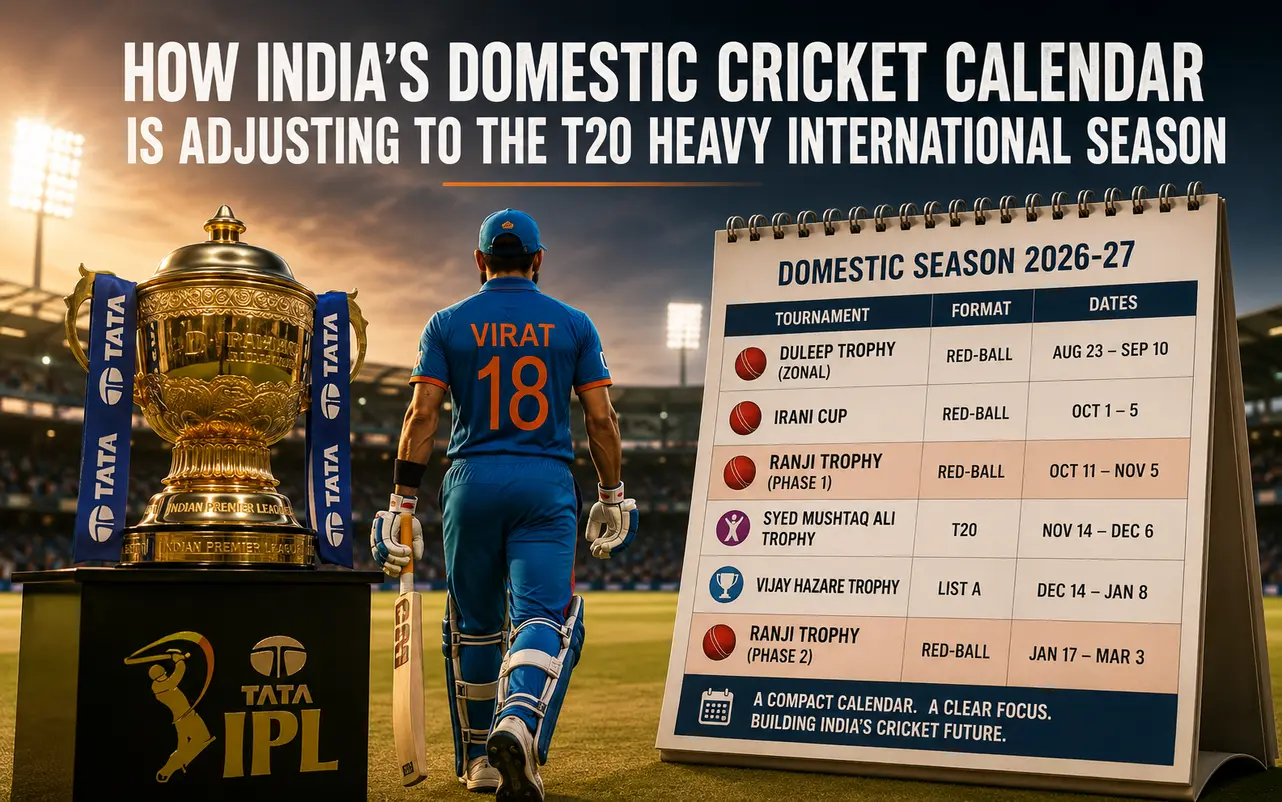
India’s domestic cricket calendar is changing. The old rhythm of long Ranji Trophy seasons followed by shorter white-ball tournaments is gone. The international schedule is packed with T20 cricket. The IPL takes up nearly two months. Players are travelling more and resting less. The BCCI had to find a way to fit everything in. The 2026-27 domestic season has 1,788 matches across eight categories, from senior men to Under-15 women. The season starts on August 23 with the Duleep Trophy and runs through March 2027. The Ranji Trophy is split into two phases. The white-ball tournaments are squeezed into the gaps. This is how India’s domestic calendar is adjusting to the T20-heavy international season.
Why India’s Domestic Season Is Being Restructured
The calendar is being reshaped by three forces. More T20 internationals. A longer IPL. And the need to manage player workload. India’s international home season alone has 22 matches across 17 cities, featuring West Indies, Sri Lanka, Zimbabwe, and Australia. The away tours to England, Ireland, and Sri Lanka add another layer. There is simply less time for domestic cricket.

The Rise Of T20 Scheduling Pressure
T20 cricket is everywhere. The IPL window has grown. The ICC has added more T20 World Cups. Franchise leagues are expanding. The BCCI is even exploring moving the IPL from the March-May window to address player exhaustion and extreme heat. Arun Singh Dhumal has signalled that a larger IPL window is likely in the next FTP cycle. This means domestic cricket has to work around T20 commitments, not the other way around.
What This Means For State Teams
State associations are feeling the squeeze. Their best players are often away on national duty or playing in the IPL. The two-phase Ranji Trophy format helps. The first phase runs from October 11 to November 5, then pauses for the white-ball block. The second phase resumes on January 17 and runs to February 4. This gives state teams a clearer window to have their top players available. But it also means shorter preparation time and more compact scheduling.
| Tournament | Format | 2026-27 Window |
| Duleep Trophy | Red-ball (Zonal) | August 23 – September 10 |
| Irani Cup | Red-ball | October 1 – 5 |
| Ranji Trophy (Phase 1) | Red-ball | October 11 – November 5 |
| Syed Mushtaq Ali Trophy | T20 | November 14 – December 6 |
| Vijay Hazare Trophy | List A | December 14 – January 8 |
| Ranji Trophy (Phase 2) | Red-ball | January 17 – March 3 |
India Cricket Calendar 2026 And Its Main Pressure Points
The 2026 calendar is packed from start to finish. The IPL ends on May 31. The one-off Test against Afghanistan starts on June 6, giving players only a six-day gap. Then comes the tour of Ireland and England from late June to mid-July. After that, India travel to Sri Lanka for two Tests and possibly three T20Is. The home season starts in September with West Indies, followed by Sri Lanka in December, Zimbabwe in January, and Australia for the Border-Gavaskar Trophy from January 21 to March 3.
International Cricket Leaves Narrow Gaps
The gaps between series are getting smaller. The IPL final and the Afghanistan Test are only six days apart. The England tour ends on July 19, and India could be in Sri Lanka soon after. The domestic season has to fit into the spaces left behind. This is why the BCCI compressed the Ranji Trophy into two phases and placed the white-ball tournaments in the November to January window.
Why July To December Matters Most
The second half of the year is critical for domestic cricket. The Ranji Trophy’s first phase happens in October and November. The Syed Mushtaq Ali Trophy runs from November 14 to December 6. The Vijay Hazare Trophy follows from December 14 to January 8. These tournaments are squeezed into a period when international cricket is relatively quiet. The timing of the Syed Mushtaq Ali Trophy is also designed to allow talent scouts to prepare their lists before the IPL auction, which is usually held in December.
Domestic Cricket In India 2026 And Player Development
Even with all the T20 pressure, domestic cricket remains the main pipeline for national selection. The BCCI has made it clear that red-ball cricket is still a priority.
Why First Class Cricket Still Matters
First-class cricket builds skills that T20 cannot replace. Technique is developed in the longer format. Patience is also built there. Bowling workload tolerance is another key skill. The Ranji Trophy continues to be played in a two-phase format. This ensures adequate recovery time for players. It also prioritises multi-day cricket. The Col. CK Nayudu Trophy Winners vs Rest of India match has been reinstated. This provides an enhanced competitive platform for emerging U-23 cricketers.
Where T20 Cricket Helps The Most
T20 cricket develops sharper batting tempo. It builds pressure bowling skills. It also improves athletic standards. The BCCI has converted the Men’s U23 State A Trophy and the Vizzy Trophy from one-day competitions to T20 tournaments. This aligns domestic cricket with the evolving demands of the modern game. Coaches like Usman Gani see this as a logical decision because talented U-23 cricketers can feature in both Vijay Hazare and Ranji Trophy while also playing T20s.
Skills Gained From T20 Cricket
- Sharper batting tempo and strike rotation
- Death bowling and yorker execution
- Higher fielding intensity and athletic standards
- Pressure handling in tight finishes
Skills Protected By Red Ball Cricket
- Technical batting against swing and seam
- Patience and concentration over long periods
- Bowling workload management and stamina
- Building innings and match awareness
How The Domestic Schedule Is Adapting
The BCCI is making practical changes to keep domestic cricket alive and relevant.
More Compact Tournament Blocks
Tournaments are grouped into shorter blocks to minimise disruption. The Ranji Trophy’s first phase lasts only four rounds from October 11 to November 5. The Syed Mushtaq Ali Trophy is completed in just over three weeks. The Vijay Hazare Trophy runs for about three and a half weeks. This helps players move between domestic and international duties.
Greater Focus On Recovery Time
The two-phase Ranji Trophy format gives players adequate recovery time. The Vijay Merchant Trophy (Under-16) has been moved to the November-January window. This allows young cricketers more time to prepare for annual and board examinations. These exams are usually held in February and March. The knockout stages of the Cooch Behar Trophy Elite Group will be played in Bengaluru and Mysuru. This ensures competitive balance during the January window.
Strengths Weaknesses Opportunities Threats
Strengths And Weaknesses
Strengths: The domestic calendar is flexible. The two-phase Ranji format allows for white-ball tournaments to be held in between. The number of matches is massive, with 1,788 games across age groups and genders. Players get exposure to all three formats at the domestic level.
Weaknesses: The calendar is overloaded. International commitments leave little room for domestic cricket. State teams lose their best players to national duty. They also lose them to the IPL. The scheduling is very tight. Some tournaments overlap with international series.
Opportunities And Threats
Opportunities: The conversion to T20 format creates more opportunities. The young players can impress before the IPL auction. The timing of the Syed Mushtaq Ali Trophy helps talent scouts. They can prepare their lists ahead of the IPL auction.
Threats: Player burnout is a real concern. Former IPL chairman Lalit Modi has criticised the BCCI for overworking players. Sunil Gavaskar has urged the BCCI to give players a month-long break and warned against cheapening the India cap. The relentless schedule means players have minimal recovery time. And are increasing the risk of injuries.
What The Future Indian Cricket Season Schedule Could Look Like
A Better Balance Between Formats
India needs clear format windows. The Ranji Trophy should have protected time without international cricket interrupting it. The white-ball tournaments should be placed in dedicated blocks. The BCCI has already started moving in this direction by splitting the Ranji Trophy into two phases and placing the Syed Mushtaq Ali Trophy and Vijay Hazare Trophy in between. But there is more work to do. The domestic schedule must be protected from the constant expansion of the international and franchise calendar.
Building Smarter Player Pathways
A better calendar can create smoother progression from domestic cricket to India selection. The reinstatement of the Col. The CK Nayudu Trophy Winners vs Rest of India match is a step in the right direction. The format gives young players more exposure to the shortest format. But the pathway must also include planned exposure, rest, and role clarity. Players need time to develop their skills without being rushed into the senior side
Conclusion
India’s domestic season is not shrinking in importance. It is changing shape to survive the demands of modern cricket. The BCCI has scheduled 1,788 matches across the 2026-27 season. The Ranji Trophy is split into two phases. The white-ball tournaments are squeezed into the gaps.
The U-23 tournaments have been converted to T20 format to align with the modern game. But the challenges are real. There is just too much cricket on the calendar. International matches are taking up so much time that players barely get to play domestic cricket. The next step is to create clear time slots for different formats. The domestic season needs to be protected from constant expansion. Smart scheduling helps both player performance and talent development. Now BCCI needs to find the right balance.
Want more in-depth cricket analysis, match previews, schedules, and the latest updates? Follow Online Cricket ID for fresh, reliable cricket articles every day and stay ahead of every big cricket story.
