


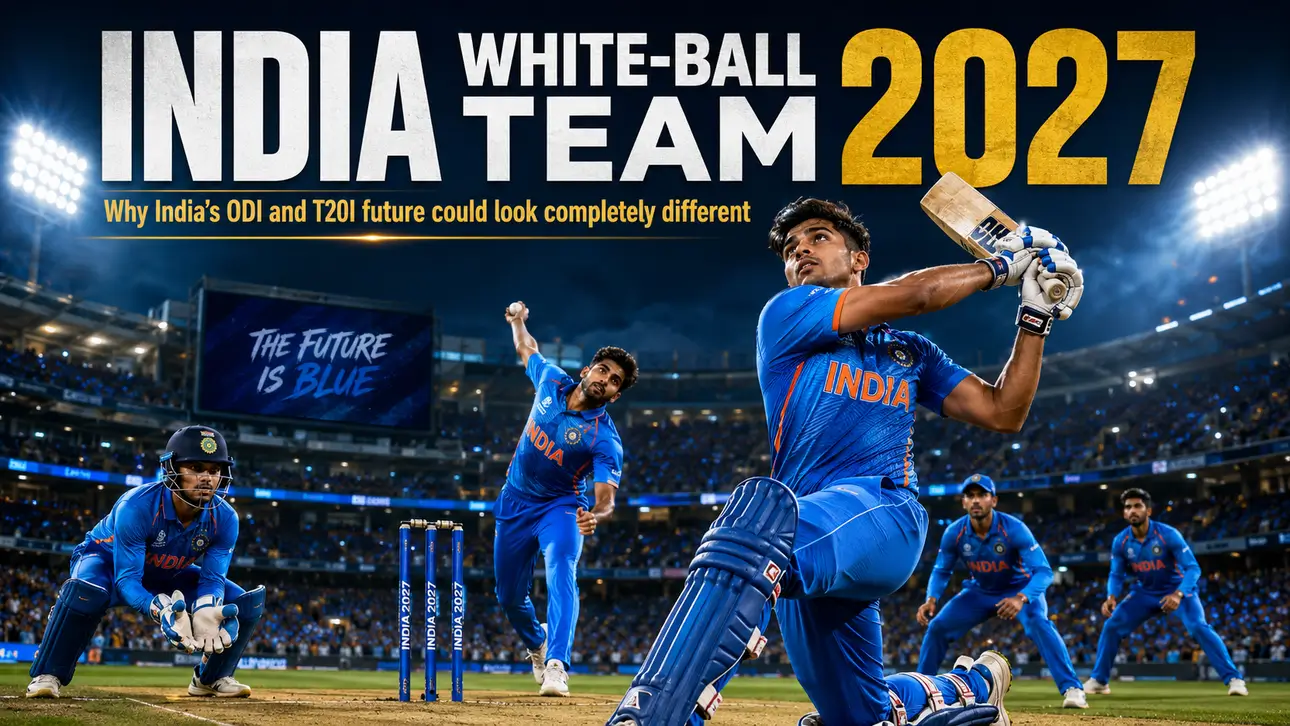
Indian cricket has not simply been transitioning — it has been transforming at a pace that even its most optimistic architects could not have scripted. The India white ball team 2027 prediction conversation is no longer a speculative exercise. It is a live tactical operation.
With Shubman Gill confirmed as ODI captain, Suryakumar Yadav leading the T20I side, Gautam Gambhir at the helm as head coach through December 2027, and a fresh generation of explosive batters and high-pace bowlers rewriting benchmarks in every bilateral series and IPL tournament, the picture of what India’s limited-overs teams will look like by the next ODI World Cup is becoming clearer with each passing month.

In this article, we map that transformation, the retirements already absorbed, the transitions still in progress, and the emerging core that is staking its claim to define Indian white-ball cricket for the next decade.
Phasing Out The World Cup Winning Golden Generation
The extraordinary thing about this transitional phase is that it has unfolded on top of unprecedented success. India entered it as defending champions across formats — ICC T20 World Cup 2024 winners, ICC Champions Trophy 2025 winners, and ICC T20 World Cup 2026 winners on home soil.
The golden generation of Rohit Sharma, Virat Kohli, Jasprit Bumrah, and Ravindra Jadeja did not fade out in defeat. They handed over the baton at the summit. That context matters because it has changed how India’s selectors approach the India t20 team transition after rohit kohli. They are not rebuilding from scratch.
They are evolving from strength, with the luxury of time, established systems, and a talent pool deeper than almost any cricket nation has seen at one moment. The question now is not whether the next generation can replace the gold standard. It is whether the selectors can manage that transition without disrupting the extraordinary consistency that has defined Indian cricket since 2022.
Navigating The Transition After Rohit And Kohli
Virat Kohli announced his T20I retirement immediately after India’s 2024 T20 World Cup triumph in Barbados — a typically decisive gesture, with Kohli explicitly stating he wanted to pave the way for the upcoming generation. Rohit Sharma followed in the same announcement, confirming this was his last T20 World Cup.
Their absence has opened structural vacancies at the top of India’s T20I order that selectors have been actively and successfully filling. Abhishek Sharma, who hammered 563 runs at a strike rate of 204.72 across 15 IPL 2026 innings including a century and four fifties, has established himself as India’s primary aggressive powerplay option in the shortest format.
Ishan Kishan’s extraordinary 602 runs at a strike rate of 182.42 in IPL 2026, having moved to the top of the order following SRH’s reorganisation, has given India’s T20I batting a left-handed disruptor that no amount of planning around Kohli’s batting style could have generated.
In the ODI format, Kohli has reaffirmed his commitment to the 2027 World Cup as recently as May 2026 — his ODI form remains elite, and selectors are building their middle order around him rather than beyond him for the moment. The T20I vacancies, however, belong to the new generation.
Modern Scheduling Demands Accelerate Squad Rotation
India played 19 T20Is, 14 ODIs, and 10 Tests between January and June 2026 alone — a schedule density that would have been considered extreme even three years ago. Against this relentless calendar, the India limited overs roadmap till 2027 has been designed with deliberate rotation built in. Head coach Gautam Gambhir operates an explicit policy: no player takes the field for all three formats across a single bilateral series unless exceptional circumstances demand it.
The practical consequence of that policy has been an accelerated integration of younger domestic standouts. Harshit Rana made the T20I squad for Ireland and England 2026 after being ruled out of IPL 2026 with injury — his inclusion reflecting selectors’ belief in his long-term role despite the setback.
Nitish Kumar Reddy, who scored 302 runs at a strike rate of 171.59 while taking 8 wickets at an economy of 10.41 in IPL 2026, is now a confirmed multi-format India regular across all three formats. Prince Yadav of LSG — 16 wickets in IPL 2026 — earned a direct India T20I call-up. The calendar is crowded. The talent pipeline is matching its demands.
Projecting The Elite Batting Core For The Next World Cup
With the 2027 ODI World Cup confirmed for South Africa, Zimbabwe, and Namibia in October-November 2027, India’s batting think tank is being stress-tested for conditions that are historically challenging: genuine bounce, seam movement under overcast skies, and pitches that reward back-foot play more than the flat-track dominance Indian batting produces at home.
The batting core being assembled reflects those demands, technically correct anchors at the top, an explosive middle order capable of rebuilding rapidly after setbacks, and finishers who can attack any bowling on any surface.
Shubman Gill At The Helm Of Strategic Operations
Shubman Gill is no longer the crown prince of Indian cricket — he is the king. Confirmed as India’s full-time ODI captain following Rohit Sharma’s departure from the captaincy role, Gill’s leadership style reflects the data-driven, long-rope approach that has defined his progression from Gujarat Titans IPL captain to India’s ODI and Test skipper.
Analysts have described his captaincy as “influenced by Rohit’s empathy and MS Dhoni’s calmness” — a combination of measured patience and tactical intelligence that works particularly well in the ODI format’s longer decision-making cycles. As a batter, Gill is the foundation around which India’s entire india 2027 world cup probable squad is being built.
His ability to survive the new ball on pace-friendly overseas surfaces, combine anchor innings with acceleration in the middle overs, and bat through to power-play the last ten overs is exactly the profile South African conditions will demand. His captaincy record in bilateral series is still developing — India have won only one series as Gill the captain — but the structural groundwork is clearly being laid for 2027.
Top Order Exploding With Modern Powerplay Intent
The contrast between India’s 2023 ODI World Cup top-order setup and what is being assembled for 2027 is one of the sharpest stylistic evolutions in Indian batting history. The 2023 approach was built around Rohit Sharma’s measured powerplay aggression and Kohli’s accumulation-based anchor role.
The 2027 approach is being constructed around Yashasvi Jaiswal’s left-handed hyper-aggression, the same player who was the most glaring omission from India’s Asia Cup 2025 T20I squad simply because three equally aggressive opening options were already in the squad, and Abhishek Sharma’s extraordinary strike rate of 204.72 in IPL 2026, a number that places him among the most destructive powerplay batters in world cricket right now.
In the ODI format, the projected top order for 2027 combines the conservative solidity India occasionally needs in challenging conditions (Gill) with the modern boundary-intent style that maximises run rates in the middle overs (Jaiswal, Abhishek). The result is a top four that could look dramatically different from any India batting lineup of the last decade.
Projected India ODI Starting XI — 2027 World Cup
| # | Player | Role | Status |
| 1 | Shubman Gill | Captain, Anchor Opener | Confirmed |
| 2 | Yashasvi Jaiswal | Left-hand Aggressive Opener | Confirmed |
| 3 | Virat Kohli | Middle-order Backbone | Subject to fitness/form |
| 4 | Shreyas Iyer | Middle-order Specialist | Confirmed |
| 5 | Rishabh Pant | Vice-Captain, Keeper-batter | Confirmed |
| 6 | Tilak Varma / Rinku Singh | Explosive Finisher | Competition for slot |
| 7 | Hardik Pandya / Nitish Kumar Reddy | Seam-bowling All-rounder | Competition for slot |
| 8 | Axar Patel | Spin-bowling All-rounder | Confirmed |
| 9 | Kuldeep Yadav | Lead Wrist Spinner | Confirmed |
| 10 | Jasprit Bumrah | Lead Pace Bowler | Subject to availability |
| 11 | Arshdeep Singh / Prasidh Krishna | Seam Support | Competition for slot |
Note: Rohit Sharma’s participation depends on hamstring fitness recovery; selectors are preparing Ishan Kishan and Ruturaj Gaikwad as backup opening options.
Deep Tactical Assessment Of The Transition Blueprint
Beyond the headline names and obvious replacements, India’s white-ball transition for 2027 reveals four distinct tactical dimensions that selectors, coaches, and analysts are actively managing. Here is an honest assessment of each.
Formidable Power-Hitting And Multidimensional Assets
India’s greatest single advantage heading into the 2027 cycle is the sheer depth of its India next generation white ball core — both in terms of batting firepower and bowling versatility. No other cricket nation currently possesses this combination of assets at this scale.
Top Three Technical Assets of India’s Emerging White-Ball Core:
- Boundary-percentage batting across every position: From Abhishek Sharma’s 204.72 powerplay strike rate to Rinku Singh’s exceptional List A record averaging nearly 50, India can post 50 in the powerplay and 60 in the death overs — with different batters capable of delivering each — making every phase of their batting genuinely match-decisive.
- Seam-bowling all-round options: Nitish Kumar Reddy provides Test-level seam bowling combined with a T20 strike rate of 171.59. Hardik Pandya offers elite finishing combined with 140 kph-plus pace. India has at least three players capable of batting at six and bowling three legitimate international-quality overs — a structural depth that other nations openly envy.
- Wrist-spin variety: The combination of Kuldeep Yadav’s left-arm wrist spin and Ravi Bishnoi’s leg-spin gives India a dual-wrist-spin option that no other Test-playing nation can match in the current era — and both are effective in South African conditions where slow pitches occasionally turn.
Early Execution Vulnerabilities And Lack Of Defensive Anchors
Brutal honesty about this squad requires acknowledging the gaps alongside the strengths. India’s next generation white ball core is built for scoring quickly — which creates a structural vulnerability in conditions designed to slow scoring down.
South Africa’s early-morning sessions under overcast skies, where genuine seam movement is available for pace bowlers, will test every India batter in the 2027 squad in ways that flat-track IPL seasons and home bilateral series simply do not. India’s current top-order options are exceptional attackers.
They are less proven as defensive anchors, players who can absorb 30 overs of quality seam bowling, keep their wicket, and manufacture runs against swing in unhelpful conditions. This is the vulnerability that selectors must address through the 18 bilateral ODIs India are scheduled to play before mid-2027, deliberately using overseas tours against quality pace attacks as technical development opportunities rather than results-first exercises.
Massive Developmental Pathways In Emerging Global Tournaments
The India limited overs roadmap till 2027 is designed around a specific sequence of high-value developmental opportunities. India are scheduled to play approximately 20 ODIs before mid-2027, offering enough laboratory time to experiment with combinations and identify the squad’s most functional balance under pressure.
The upcoming tours of England (where seam movement will test the top order), away series in Australia (where bounce and pace create different technical challenges from those India typically faces), and the home series against South Africa and New Zealand in early 2027 are all specifically designed to stress-test the combinations under construction.
Additionally, franchise league exposure across the SA20, BBL, and The Hundred continues to give younger Indian players experience of overseas conditions that previous generations only accessed through bilateral series.
Excessive Match Loads And Risk Of Physical Fatigue
The single most significant threat to India’s 2027 ambitions is one that coaching strategy cannot solve — physical burnout in a generation of cricketers who have never known anything other than a congested global calendar. Rohit Sharma himself missed several IPL 2026 matches due to a persistent right hamstring injury, a fitness concern that is shaping selectors’ contingency planning for 2027.
Jasprit Bumrah’s workload management remains the most delicate balancing act in Indian cricket, with the coaching staff now explicitly managing his appearances to protect him for the World Cup. Among younger players, the combination of IPL (60+ days), international tours, and domestic obligations creates a schedule that sports science staff openly acknowledge is unsustainable without rigorous load management.
Harshit Rana’s IPL 2026 injury, ruling him out for the second half of the season, is a direct product of this load. Nitish Kumar Reddy’s back concerns in Test cricket earlier this year are another data point in the same warning graph. India’s medical and sports science infrastructure is world-class. The test is whether it can apply that infrastructure at a sufficient scale to keep 15 players simultaneously match-fit through October 2027.
Defining The Next Generation Bowling Revolution
If India’s batting transition is remarkable in its depth and speed, the bowling transformation is perhaps even more fundamental. The attack that India will field in 2027 will look categorically different from the one that won the 2023 ODI World Cup.
The Bumrah-Siraj-Shami-Kuldeep combination that was near-unplayable in home conditions is being remodelled around india odi t20 squad changes by 2027 that reflect a younger, higher-pace, more variation-rich bowling group.
Express Pace And Smart Variations Dominating Selection
Two names are central to understanding India’s bowling future: Mayank Yadav and Harshit Rana.
Mayank Yadav, the 23-year-old LSG pacer from Delhi, made his T20I debut against Bangladesh in October 2024 and immediately registered a maiden over with his first international delivery — the third Indian bowler in history to achieve that feat on debut, after Ajit Agarkar and Arshdeep Singh. Bowling comfortably at 150 kph and above, his raw pace is the highest among India’s current group of pace bowlers.
His injury history requires careful management, but when fit, he creates problems that even elite international batters simply cannot pre-meditate around. In 50-over cricket’s middle phases, where batters are typically settled, a bowler capable of suddenly bowling five consecutive deliveries at 152 kph is a tactical weapon of a different order.
Harshit Rana, 24, brings complementary skills, his right-arm pace with natural away-seam movement gives India a third pace option capable of exploiting the new ball’s conditions in South African-style pitch environments.
He was India’s most wicket-taking ODI bowler in the NZ series of January 2026, taking 6 wickets while Kohli topped the batting charts. His dual-skill profile (aggressive 120+ strike rate batting in the lower order) makes him a structural asset rather than a one-dimensional specialist.
Wrist Spin Supremacy And Defensive Cushion Options
India’s wrist-spin bowling combination for 2027 will likely be built around Kuldeep Yadav and Ravi Bishnoi — and the contrast between the two makes them complementary rather than competitive assets. Kuldeep, at 31 by 2027, brings experience, craft, and the ability to bowl both an attacking and a defensive over depending on match situation.
His 2025 Champions Trophy performances, which included match-defining spells against Pakistan and South Africa, demonstrated that he remains one of the three or four best ODI spin bowlers in the world. His leading role in drying up runs in overs 11-40 is something India’s coaching staff consistently cite as non-negotiable.
Bishnoi’s value is different, he is a pure wicket-taker who sets traps early and executes the decisive googly at the moment the batter least expects it. His 11 wickets at an average of 23.36 across 9 IPL 2026 matches for RR — including a best of 4/41 — represent the sustained wicket-taking returns that IPL performance tends to translate into international selection for spinners.
Comparative Bowling Statistics — Young India Pace & Spin Prospects (IPL 2026)
| Bowler | IPL 2026 Wickets | Economy | Avg Speed | India Format |
| Arshdeep Singh | 12+ (Death Overs) | ~8.3 | 136 kph | T20I + ODI |
| Harshit Rana | Out Injured | — | 142 kph | T20I + ODI |
| Nitish Kumar Reddy | 8 | 10.41 | 135 kph | T20I + ODI + Test |
| Prince Yadav | 16 | ~9.0 | 140 kph | T20I Select |
| Ravi Bishnoi | 11 | 9.88 | — | T20I + ODI |
| Varun Chakravarthy | 11 | 8.78 | — | T20I |
The Limited Overs Roadmap Leading To The Next Global Championship
The path between now and October 2027 is mapped with deliberate precision by India’s think tank. From the Afghanistan home ODI series in June 2026 — Gill’s squad featuring Jaiswal, Sai Sudharsan, Rishabh Pant, and Nitish Kumar Reddy as the primary development group — through the England bilateral tour in July 2026, to the planned South Africa and Australia away assignments in the back half of the year, every series has a specific selection objective.
The England tour in July 2026 is the most important single window in the India limited overs roadmap till 2027. English conditions — swing, seam, overhead cloud cover, fast outfields — are the closest equivalent available in bilateral cricket to the challenging conditions India will encounter in South Africa in 2027.
Batting there against Anderson-era replacements like Gus Atkinson, bowling at a batting lineup that attacks from the top with Zak Crawley-style powerplay intent, and managing the tactical demands of day-night ODI cricket in a foreign time zone will collectively tell India’s selectors more about their 2027 readiness than any amount of home series success.
The subsequent 2026-27 Australian summer, if India tour as scheduled, provides the second-most valuable preparation window — South African and Australian conditions share the bounce and pace characteristics that IPL cricket simply cannot replicate. By March 2027, India should be close to finalising their best 15, with six months still remaining to manage workloads, recover from injuries, and ensure the squad arrives at the tournament with every player at full physical capacity.
Final Projections On The White Ball Squad Of The Future
The structural shift in India’s white-ball cricket between 2024 and 2027 is not incremental. It is generational. And it is arriving on the back of a run of ICC success that has given Indian cricket the luxury of managing this transition from a position of total strength rather than crisis.
By October 2027, the India ODI squad will in all likelihood feature Shubman Gill leading a batting lineup where Rohit Sharma’s presence is contingent on fitness (with Jaiswal and Ishan Kishan fully capable of filling that opening slot if necessary), Kohli at number three remains the backbone provided his form and body allow it, and a middle order built around Rishabh Pant’s explosiveness, Rinku Singh’s finishing genius, and Nitish Kumar Reddy’s multi-format versatility.
The bowling attack will combine Bumrah’s continuing pre-eminence with the raw pace of Mayank Yadav and Harshit Rana, the wrist-spin variety of Kuldeep and Bishnoi, and the all-round balance of Axar Patel and Hardik Pandya. It will be a team that plays with structural aggression at both ends of the innings, bowls with more pace than any previous India ODI attack, and fields with an athleticism that reflects how deeply the T20 generation’s fitness standards have been adopted across all formats.
Crave more deep dives into the future of cricket? Follow Online Cricket ID today to get your daily dose of expert analysis, breaking news, and exclusive updates!
