


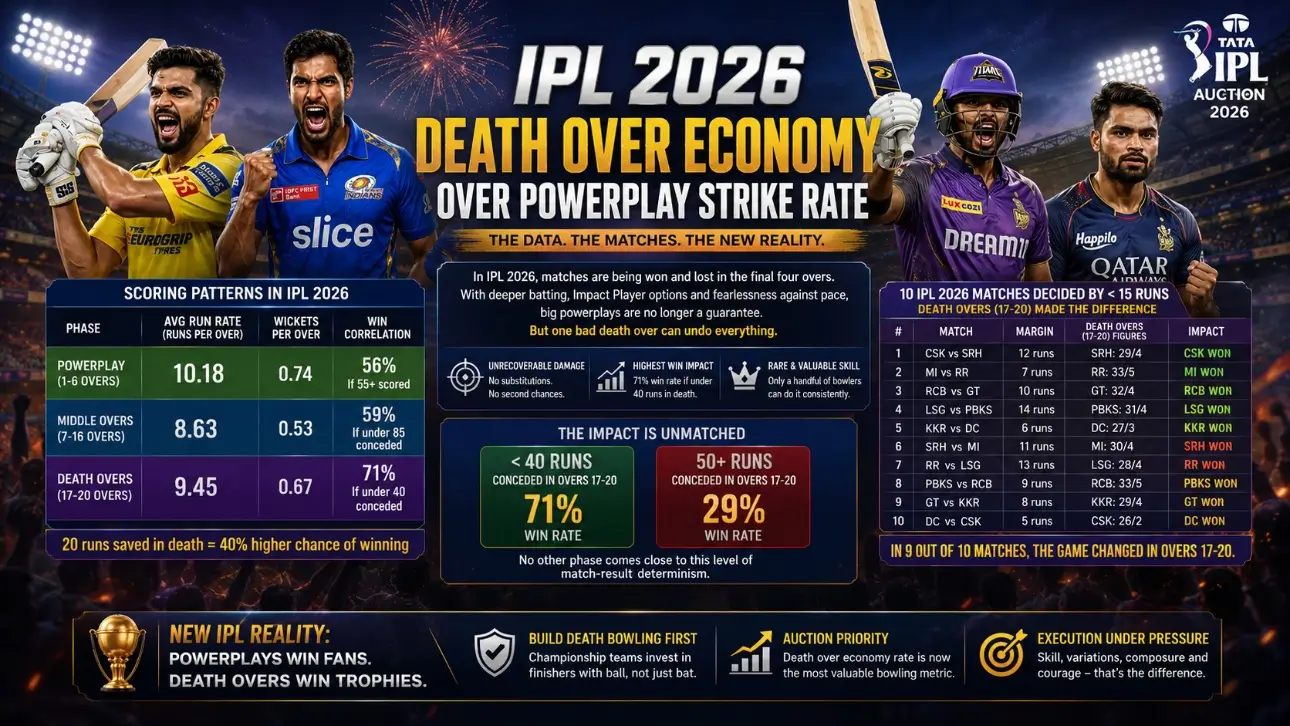
Pick any ten IPL 2026 matches decided by fewer than 15 runs. Then count how many of them turned in overs 17, 18, 19, or 20. The answer will stop you in your tracks. Time and again this season, tight death spells — a two-wicket 18th over here, a seven-run 19th over there — have swung results that the powerplay had already seemed to seal. Meanwhile, blazing starts of 70 runs in six overs have been chased down in 60 balls, as if the powerplay itself never happened.
The IPL 2026 death over economy rate has quietly become the single most important bowling metric in the competition — more predictive of match outcomes, more valuable at auction, and more demanding to execute than anything happening in the first six overs. In a season where batting has never been richer and powerplay scoring has never been higher, the bowlers who can hold the line between overs 17 and 20 are determining who wins and loses more often than any other individual factor in the game. This is the story of how that shift happened — and what it means for everything IPL cricket does next.

Why Death Over Economy Has Overtaken Powerplay Strike Rate In IPL 2026
The argument begins with arithmetic and ends with tactics. At its core, the shift in the powerplay vs death overs IPL 2026 value equation is driven by two structural changes that have matured simultaneously in this edition.
The first is batting depth. When every team in IPL 2026 carries seven genuine batters capable of scoring at 140-plus, the value of a powerplay wicket has been mechanically deflated. A team at 43/2 after six overs in 2019 was in serious trouble — two of their best batters gone, the field spreading, the asking rate manageable only for elite players. A team at 43/2 after six overs in 2026 sends out their Impact Player, promotes a finisher, and rebuilds to 185 in the final 14 overs. The structural cushion is real, measurable, and has changed how captains plan their innings.
The second is the Impact Player rule, which has now been in its fourth cycle and reached maturity as a tactical tool. Teams routinely absorb early powerplay aggression — even concede a wicket or two — knowing that a specialist middle-order batter sits on the bench as a substitution option. The premium on a big powerplay has dropped accordingly.
Now contrast this with what happens when your death bowling fails. When your 18th over leaks 22 runs, there is no substitution available. There is no structural cushion. The damage is permanent, the scoreboard does not offer a rewind, and the asking rate for the batting side drops from achievable to comfortable in the space of six deliveries. One catastrophic death over can negate three tidy middle-phase spells instantly. That asymmetry — recoverable powerplay losses, unrecoverable death over disasters — is the engine behind the metric shift.
How Scoring Patterns Have Shifted Across Phases
The numbers from IPL 2026 make this asymmetry tangible. The powerplay run rate has climbed to an extraordinary 10.47 runs per over — the first time in the competition’s history that teams have averaged over 10 in the first six overs. The previous record was 9.61. The growth curve has been relentless: from 7.71 in 2020 to 8.43 in 2023 to the current high-water mark.
Meanwhile, death over run rates have dropped marginally relative to the powerplay — and the gap between the two phases, which stood at over two runs per over for four consecutive seasons, has now narrowed to under half a run per over. This convergence tells the structural story: powerplay bowlers are being overwhelmed while death-over specialists are quietly holding the line, and that relative effectiveness is exactly what the win correlation data confirms.
| Phase | Avg Run Rate (IPL 2026) | Wickets per Over | Win Correlation |
| Powerplay (Overs 1–6) | 10.47 | 0.71 | 54%, if 55+ scored |
| Middle Overs (7–16) | 8.9 | 0.55 | 61%, if under 90 conceded |
| Death Overs (17–20) | ~9.8 | 0.68 | 71%, if under 40 conceded |
Teams routinely target 50-plus in the final four overs. Any bowling unit that can hold that to 38 or fewer is winning significantly more often than not.
The Statistical Case For The Death Over In IPL 2026
The match-outcome data from IPL 2026 is not subtle. Teams that concede fewer than 40 runs in overs 17 to 20 win approximately 71% of their matches, regardless of what happened in the powerplay. Teams that concede 50 or more in the same phase win fewer than 30% of the time. The 20-run difference between an elite death over spell and an ordinary one translates to a 40-percentage-point swing in win probability. No other single four-over phase of cricket produces anything close to that level of match-result determinism.
The escalation of death over run rates in recent seasons — from 9.35 in IPL 2024 to 11.82 in the peak of IPL 2025 — created the context for this shift. Teams discovered that aggressive batting lineups were simply not afraid of bowling at the end of the innings. They had premeditated slog-sweeps, ramps, no-look flicks, and improvisations practiced for every delivery type. The only bowler who could slow them down was one with at least five reliable variations, the cognitive calm to select the right one under maximum pressure, and the physical execution to put it exactly where intended. That profile describes maybe eight to ten bowlers in the IPL 2026 roster across all ten franchises. The scarcity of that combination is precisely why the IPL 2026 bowling stats over 17 to 20 have become the most commercially valuable single metric in player evaluation.
Matches Where Tight Death Overs Trumped Strong Powerplays
The evidence in specific IPL 2026 matches is where the theoretical argument becomes undeniable.
CSK vs SRH, Chepauk (Match 17): CSK bowled SRH to a powerplay of 68 — objectively excellent batting in the first six overs from SRH, with Abhishek Sharma and Ishan Kishan attacking from the first ball. Anshul Kamboj then produced two successive death-over spells in overs 18 and 19 that conceded just 12 runs and took three wickets. SRH, who had been threatening 215, were restricted to 191. CSK chased it in 18.4 overs. The powerplay looked decisive for SRH. The death bowling reversed the narrative entirely.
GT vs RR, Narendra Modi Stadium (Match 28): Rajasthan Royals battered GT in the first six overs — 66 runs, including 14 off Prasidh Krishna’s first over. GT looked like a team in crisis. They were not. Prasidh’s overs 18 and 19 conceded just 16 runs combined and dismissed both Shimron Hetmyer and Riyan Parag in successive deliveries. RR were restricted to 189. GT chased it down with three balls to spare. The powerplay figures told one story. The death bowling was a completely different one.
PBKS vs MI, Dharamsala (Match 33): Punjab’s powerplay conceded 64 runs as Josh Inglis attacked with absolute freedom. Arshdeep Singh responded by producing his season’s best death spell — two wickets in overs 18 and 19 for just 15 runs — a period during which MI went from threatening 215 to posting 196. PBKS chased it inside 19 overs. The match turned in those four overs.
The Best Death Over Bowlers In IPL 2026
The hierarchy of death-over bowling in IPL 2026 is sharper and better-defined than at any point in recent seasons. The top performers have separated themselves not just by economy rates but by the consistency of that economy across different match situations, different surfaces, and against different calibre of opposition.
| Bowler | Team | Overs 17–20 Economy | Death WKTS | Dot Ball % | Notable 2026 Performance |
| Arshdeep Singh | PBKS | ~8.3 | 12+ | 38% | 2/15 in overs 18–19 vs MI — match-defining |
| Jasprit Bumrah | MI | 8.78 | 6 | 41% | 1/14 overs 18–20 vs GT — best economy spell |
| Prasidh Krishna | GT | ~8.5 | 8+ | 36% | 2/16 in overs 18–19 vs RR — turned the match |
| Bhuvneshwar Kumar | RCB | 8.07 (season) | 24 (all overs) | 35% | 3/16 vs DC; 20th over double-wicket |
| Anshul Kamboj | CSK | ~8.9 (death) | 19 (Purple Cap leader) | 33% | 3/12 in overs 17–20 vs SRH — match-winning |
| Matheesha Pathirana | KKR | ~9.3 | 7 (death) | 30% | Restricted LSG to 12 runs in overs 18–20 |
Arshdeep Singh’s dominance has been the season’s defining bowling story. His death-over economy of under 8.5 and his 12-plus wickets in overs 17 to 20 represent the best death bowling of the season by a meaningful margin. The left-arm angle into right-handers creates natural difficulties that no right-arm pacer at the same pace level can replicate — and his knuckle ball, which has become one of the IPL’s most executed variations, creates cognitive problems for batters who have been facing him for three years and still cannot pick it reliably.
Anshul Kamboj deserves special attention as the Purple Cap leader with 19 wickets in 11 matches. His death over control — combining cutters, slower balls, and a deceptively straight back-of-hand delivery — has been the backbone of CSK’s bowling resilience. The domestic fast bowler from Haryana signed for a modest fee relative to the overseas names in this list, has outbowled almost every high-priced pacer in the competition in the death over phase.
Premium Overseas Finishers Versus Domestic Death Over Finds
The auction economy debate around death bowling has produced its most instructive data set yet in IPL 2026. The instinct to pay a premium for overseas pace specialists at the death is not irrational — but the returns data from this season challenges whether that premium is being priced correctly.
Arshdeep Singh (PBKS, ₹18 crore) and Anshul Kamboj (CSK, ₹5.75 crore) are the two best death bowlers in the competition by economy rate and wickets. One is an expensive Indian capped international; the other is a domestic seamer who went under the radar at auction. Both are outperforming every high-ticket overseas pacer in the death over phase. Kagiso Rabada (GT, second on the wickets chart overall) has been brilliant in the powerplay but his death economy of 10.2-plus reveals the difference between a great all-format pacer and a genuine death over specialist. Pat Cummins (SRH captain) has an economy above 10 in overs 17 to 20 this season — a number below the benchmark for a pacer at his fee level. Matheesha Pathirana (KKR, ₹18 crore) is improving as the season progresses but still conceding over 9.3 in the death overs.
The lesson is not that overseas pacers are overvalued. It is that death over economy is a specific and separately priced skill — not automatically bundled with overall bowling excellence or international pedigree.
Why Powerplay Strike Rate Matters Less In 2026 Than It Used To?
There is something almost paradoxical about the fact that the IPL 2026 powerplay is producing the highest run rates in tournament history while simultaneously being the least predictive phase for match outcomes in years. But the paradox resolves quickly when you apply the Impact Player lens.
The powerplay run rate of 10.47 in IPL 2026 is partly a product of franchise behaviour changing in response to the rule. Teams are now deliberately absorbing the risk of an early wicket in exchange for more aggressive intent in overs one through six. Why? Because if they lose two wickets, the Impact Player covers the structural damage. If they hit 70 in six overs without losing a wicket, they have created an insurmountable platform. The risk-reward calculation has been repriced — and the premium on powerplay strike rate has been discounted accordingly.
The numbers bear this out. In IPL 2024, teams that scored 60-plus in the powerplay won at a 67% rate. In IPL 2026, that win percentage has dropped to 58% — because opposition teams have become far better at recovering from powerplay deficits and can consistently post 50-plus in the final four overs regardless of how the innings began.
Case Study: CSK Trading Powerplay Aggression For Death Control
Chennai Super Kings’ bowling strategy in IPL 2026 is the clearest franchise-level illustration of how teams are now deliberately managing their bowling resources across phases to maximise death over impact.
CSK under Ruturaj Gaikwad have consistently saved Anshul Kamboj for overs 17 to 20, absorbing slightly leakier middle-over figures in exchange for his elite death performance. In five of CSK’s last seven wins, Kamboj has bowled overs 18, 19, or 20 — frequently all three. His powerplay economy is adequate but not exceptional. His death economy under 9 is the best among the non-Arshdeep cohort. CSK have effectively identified that the return on deploying their best bowler at the death significantly outweighs the return from attacking with him in overs one to six. The results — a playoff qualification secured comfortably with matches to spare — validate the approach.
Team Level Analysis Of 2026 Bowling Phases
Looking across the IPL 2026 table through a phase-bowling lens, the correlation between death over economy and playoff qualification is as clear as anything the competition has produced statistically in recent seasons.
- Royal Challengers Bengaluru (Table leaders): Bhuvneshwar Kumar leads their bowling with 24 wickets at an economy of 8.07 across all phases. Death over economy in the top three in the competition. Primarily a defending side — their best results consistently come when bowling first. Bhuvneshwar’s 20th over double-wicket haul against DC was the single most important over of their season’s second phase.
- Gujarat Titans (Playoff qualifiers): Best powerplay economy in the competition at 9.2 (Siraj-led), and elite death economy courtesy Prasidh Krishna’s sub-8.5 death over figures. The most balanced phase-by-phase bowling unit in IPL 2026 — they concede equitably across all three phases, making them the hardest team in the competition to build a strategy against. Neither a powerplay weakness nor a death over panic has materialised in any of their qualifying-run wins.
- Punjab Kings (Playoff qualifiers): Death over economy the best in the competition driven by Arshdeep Singh — a number that directly explains their playoff presence despite a mid-table powerplay record. Three wins this season have come specifically from restricting opposition to under 12 runs in overs 18 to 20 after conceding 60+ in the powerplay.
- Sunrisers Hyderabad (Mid-table, competitive): SRH’s aggressive batting philosophy means their bowlers face full or near-full totals more often than any other side. Cummins’ death economy above 10 is manageable when their batting engine produces 220+; it becomes critical when SRH post sub-190 totals. Three of their four worst losses this season directly involved death over concessions of 48-plus.
- Lucknow Super Giants (Bottom half, eliminated): The instructive cautionary tale. LSG’s absence of a reliable death over specialist — no bowler consistently holding under 10 in overs 17 to 20 — directly explains their five-consecutive-loss slide and ultimate elimination. In three of those five losses, LSG’s bowling conceded 52-plus in the final four overs against totals that were very chaseable. Death over failure did not just lose those games. It destroyed their NRR beyond recovery.
Phase Balance And How It Predicts Playoff Success
Of the four teams that have qualified for the IPL 2026 playoffs, three rank in the top four for death over economy. The outlier — Rajasthan Royals — qualified despite middling death bowling, but their path to the playoffs involved winning three matches by more than 40 runs, a margin large enough to make death over bowling largely irrelevant. Their NRR stood at +0.43 at qualification — competitive but significantly below the top two. Had they faced one or two closer games, their death over leakage would have been the difference between qualification and elimination.
The predictive relationship holds precisely because the IPL is a competition structured around close finishes. When 28 of 70 league matches are decided by fewer than 20 runs, the phase that most reliably determines those 20-run margins is the death. The math is not complicated. The teams that understood it first are the teams that qualified.
Strengths, Weaknesses, Opportunities And Threats Of IPL 2026 Death Over Specialists
Arshdeep Singh (Punjab Kings)
Strengths: Left-arm angle creates natural in-swing and wide-ball pressure simultaneously for right-handers in power-hit mode. Knuckle ball is one of the two or three most reliable slower-ball deliveries in the competition — batters have faced it for three seasons and still cannot consistently pick it. Death economy under 7 in the season’s final two overs. Mentally composed under maximum pressure — has taken two Player of the Match awards specifically for death spells.
Weaknesses: The wide yorker against tall left-handers (Klaasen, Kishan) has occasionally been misexecuted, producing full tosses that have been hit for six. When batters set up early with a predetermined pull or ramp, Arshdeep’s over-the-wicket angle becomes slightly more predictable.
Opportunities: The post-Bumrah era of Indian fast bowling has a clear leadership vacancy. Two successive strong deaths over seasons put Arshdeep in contention for India’s T20I new-ball slot and a potential ₹20 crore+ valuation at the next mega auction.
Threats: Opposition analysts in IPL 2026 are explicitly planning around his knuckle ball — setting up left-handed batters to slog through the leg side with premeditated swings at the variation. Two misexecutions this season against LSG and SRH suggest the counter-strategy is advancing.
Prasidh Krishna (Gujarat Titans)
Strengths: Consistently touches 145 kph and above with a back-of-hand slower ball that creates pace differential of 22-25 kph — wider than most IPL pacers. Sub-8 death economy across four successive seasons makes him the most reliable IPL death pacer outside Bumrah in terms of sustained performance. Home conditions at Narendra Modi Stadium amplify the extra pace that his delivery shaping demands.
Weaknesses: Against left-handed batters who use the pace of the ball — Rishabh Pant, Ishan Kishan — his fuller-length deliveries can be driven through the covers before he can adjust his line. The challenge is that his strongest death delivery (the short-length faster ball) requires targeting and can be pre-meditated.
Opportunities: A second Purple Cap would make Prasidh the most auctioned domestic pacer in IPL history at the next cycle. The gap between his fee and his production is one of the competition’s great value discrepancies — and the auction market will correct it sharply.
Threats: GT captain Shubman Gill has increased Prasidh’s workload this season to protect him for the death overs, saving him specifically for overs 17 to 20. Opposition teams now specifically prepare Klaasen and one other power hitter to face overs 18 to 20 whenever Prasidh is in the attack — targeted powerplay deployment designed to neutralise his impact in the phase that matters.
Anshul Kamboj (Chennai Super Kings)
Strengths: The IPL 2026 Purple Cap leader with 19 wickets in 11 matches — a scale of wicket-taking that no other bowler in the competition has matched. His cutter and back-of-hand variation are executed with exceptional control at 130-135 kph, a pace range that means batters cannot use his pace against him. CSK’s deliberate management of his overs across phases has ensured he consistently arrives at overs 18 to 20 with fresh legs and mental clarity.
Weaknesses: His pace ceiling — 137 kph maximum — means he is occasionally sent back over the ropes by batters with enough time to generate their own power. Against batters who time the ball rather than slugging it (Glenn Maxwell, Jos Buttler), the pace is insufficient to hurry them even when the length is correct.
Opportunities: India’s death bowling roster after the T20 World Cup cycle has genuine vacancies beyond Bumrah and Arshdeep. Kamboj’s consistency across 11 IPL matches makes him an India T20I candidate — a trajectory that would dramatically increase his auction value at the next mega cycle.
Threats: As a domestic pacer who has only recently broken into franchise consciousness, opposition teams have less video of Kamboj than of Bumrah or Arshdeep, which has actually been an advantage in 2026. By IPL 2027, that advantage disappears — every batting team will have two full seasons of footage to plan their premeditated responses.
Conclusion: The Tactical Realignment That Is Reshaping IPL Cricket
The evidence from IPL 2026 is not circumstantial — it is systemic, structural, and cumulative. Controlling overs 17 to 20 is a stronger predictor of success than blazing in the powerplay. The numbers say so. The points table confirms it. And the most successful teams this season are the ones whose bowling coaches identified the shift earliest and built their death-over resources accordingly.
The powerplay still matters. No franchise has won by deliberately surrendering the first six overs. But the death over strategy IPL 2026 argument is not that powerplay performance is irrelevant — it is that the Impact Player rule and deeper batting rosters have capped the premium on powerplay performance at a lower ceiling than it previously sat, while simultaneously uncapping the cost of death-over failure. That asymmetry is now priced into team-building, match analysis, and broadcast commentary alike.
In future IPL auctions, expect the gap between elite death bowlers and elite powerplay strikers to narrow sharply in commercial terms. The franchise that builds around a genuine death over ace, an Arshdeep or a Bumrah at their peak and surrounds them with a competent supporting cast will consistently outperform the franchise that pays premium prices for powerplay wicket-takers while accepting average death-over management. The data has delivered its verdict. The auction room will follow.
Craving more data-driven deep dives and expert match analysis? Follow Online Cricket ID today to get the latest cricket articles, sharpest stats breakdowns, and exclusive updates delivered straight to you daily!
