


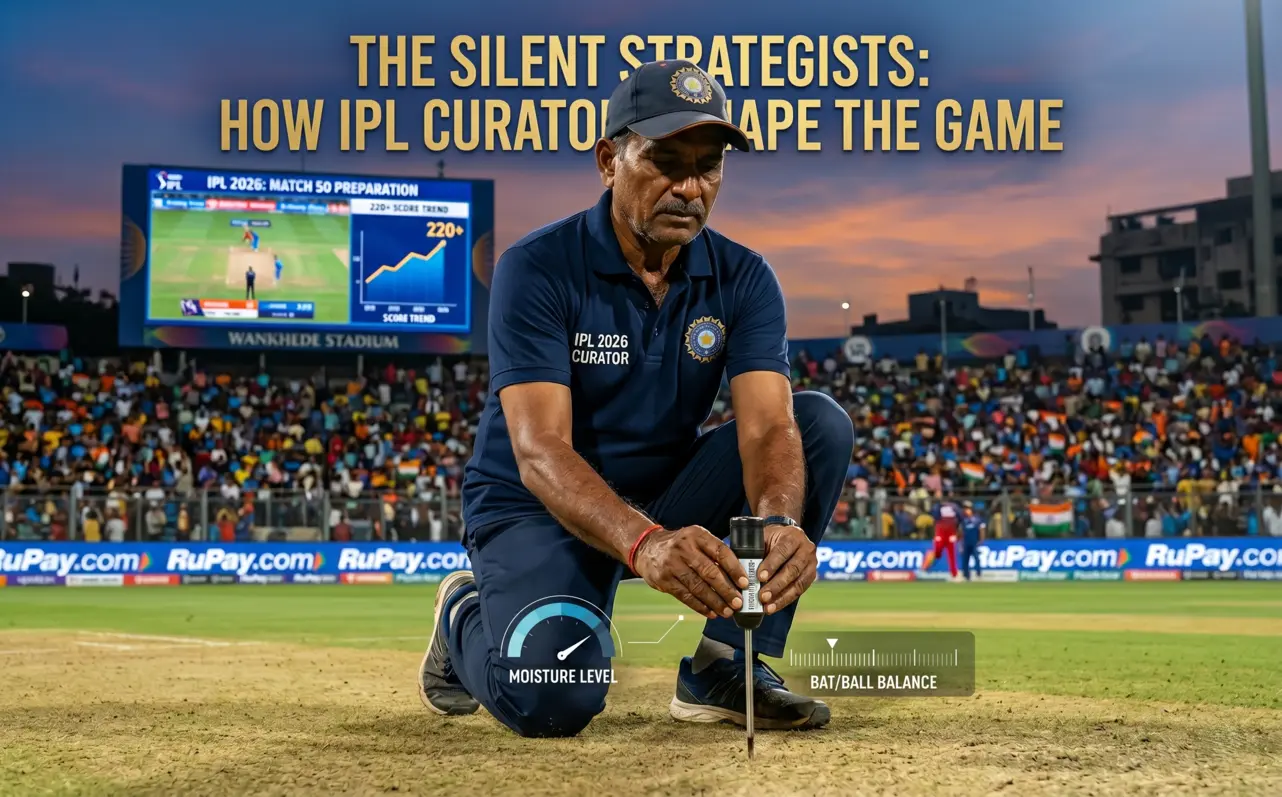
For years, the IPL was all about star players. Big batters and fast bowlers decided games. But IPL 2026 has changed that idea completely. Now the biggest impact is coming from something much quieter. The pitches.
In the first 49 matches this season, teams crossed 200 runs 41 times. That is far more than last year. Scores above 220 are now normal. Home advantage has also almost disappeared. Every ground is playing similar.

This change comes from new rules on pitch making. The BCCI has pushed for batting-friendly surfaces across all venues. Curators now follow strict instructions on grass, moisture and bounce. Even boundaries are more balanced.
Because of this, curators have become very important. They are no longer just behind-the-scenes staff. Their work now directly affects match results.
The Hidden Strategists Behind T20 Success
Evolution of Pitch Preparation in Modern Cricket
The pitch preparation has changed a lot over time. In the IPL, it was once a quiet background job. Now it is a key part of the game. Curators are no longer just ground staff. They are trained experts who shape how matches play out.
Earlier, home teams used to prepare pitches to suit their strengths. Some grounds helped spin. Others helped fast bowlers. Teams selected squads based on home conditions. This created a strong home advantage for many years.
But this also led to complaints about unfair surfaces. By 2025 and fully in 2026, the BCCI took control of pitch preparation. Now board curators work with local staff at every ground. Franchises have no say in the surface.
New guidelines also push for balanced pitches. Less extreme spin. Less swing. More even bounce. Boundaries are also more uniform.
Because of this, home advantage has dropped. Every ground now feels similar. The curator has become one of the most important figures in the IPL today.
Decoding the Curator Mindset for This Season
The curator is no longer a quiet background worker. Their role now directly affects how every match unfolds. They sit at the centre of strong and often conflicting demands.
First is the BCCI rule. The board wants batting-friendly pitches. Less help for bowlers. Even bounce. Smaller differences between venues. This is meant to create high-scoring games that keep fans engaged. Any surface that becomes too slow or too bowler-friendly can now be questioned.
Second is franchise pressure. Teams still prefer conditions that suit their squads. Spin-heavy teams want slow pitches. Pace-heavy teams want bounce and movement. But curators now have limited freedom to adjust for these requests.
Third is the balance of the game itself. If pitches are too flat, bowlers have no chance. If they are too tricky, batters fail too often. The curator must keep that balance right.
Because of these pressures, every decision matters. The curator is not just preparing the pitch. They are shaping the match itself.
Analyzing Key IPL Venues and Surface Behaviors
Identifying the Best Batting Paradises
Many stadiums have turned into full batting-friendly grounds. This is because of the BCCI rules. Boundaries are kept around 77 metres. Grass is even across the pitch. Movement in the air and off the surface is kept low. Spin is also reduced. These changes have made scoring easier than ever.
The clearest example is Wankhede in Mumbai. It has become the top batting ground this season. The average first innings score is around 222 runs. Teams are not safe even after big totals. One game saw 244 chased down. The pitch stays true. The ball comes nicely onto the bat. The outfield is quick, so even mistimed shots reach the boundary. Most games here have crossed 220 runs.
Bengaluru’s Chinnaswamy Stadium is also a major batting ground. The boundaries are short. The outfield is fast. Once batters settle, runs come quickly. Dew in night games makes chasing easier.
Across venues, scoring has gone up. But pitches now feel similar everywhere.
| Venue | City / Team | Avg 1st Innings Score (Last 3 Seasons) |
| M. Chinnaswamy Stadium | Bengaluru (RCB) | 192.5 |
| Arun Jaitley Stadium | Delhi (DC) | 190.2 |
| Eden Gardens | Kolkata (KKR) | 188.4 |
| Wankhede Stadium | Mumbai (MI) | 186.1 |
| Narendra Modi Stadium | Ahmedabad (GT) | 179.8 |
| Rajiv Gandhi Int. Stadium | Hyderabad (SRH) | 176.5 |
Where Spinners Find Turn and Bounce
Only a few IPL 2026 venues still help spinners despite flat pitch rules. Chepauk in Chennai is the main one. The black soil there slows the ball as the game goes on. Batters can score early. But it gets harder in the middle overs. Spinners get real grip and turn. Matches often slow down in the second half.
Lucknow’s Ekana Stadium is another strong spin venue. The surface is dry and low. The ball does not come easily on the bat. Spinners get more help than pacers here. Many matches at Ekana have stayed low scoring compared to other stadiums.
At Chepauk, spinners like Noor Ahmad have used the conditions well with smart changes in length. At Ekana, teams often struggle to chase. Because the pitch slows down under lights. BCCI rules have made these pitches slightly more balanced than before. Still, they remain the toughest places for batting in IPL 2026.
The Resurgence of Pace and Carry
Most IPL 2026 pitches have become flat. A few grounds still give help to fast bowlers. These venues offer pace, bounce and carry. And even under the BCCI’s strict pitch rules. The difference comes from how curators manage grass and moisture.
Eden Gardens in Kolkata is one of the key examples. The pitch has good grass cover. And stays firm under lights. Early in the innings, fast bowlers get seam movement and extra bounce. Later, batting becomes easier as the surface settles. Even then, curators avoid making it too spin-heavy or too flat.
Mohali is another ground where pace bowling gets value. The pitch has natural bounce. The ball carries nicely to the keeper. Fast bowlers can hit the deck hard and get reward. But as the match goes on, the surface slows down and spinners come into play.
New Chandigarh also offers similar help. The pitch has true bounce and allows batters to play shots. But bowlers still stay in the game. These venues show that even in a batting-heavy season, pace still survives when conditions are managed well.
How Surface Conditions Dictate Franchise Strategies
Auction Purchases Driven by Home Pitch Traits
The IPL 2026 auction showed a clear shift in thinking. Teams are no longer picking players in a general way. They are building squads based on their home pitches. Every franchise now looks at what their ground offers and buys players to match it.
Chennai Super Kings led this approach at Chepauk. Their pitch helps spin and slows down as the game goes on. So they focused on spin bowlers. They brought in Rahul Chahar and Akeal Hosein. Both are used to control runs and take wickets in the middle overs. CSK also uses them to guide younger spinners like Noor Ahmad. This keeps their spin strength strong at home.
Rajasthan Royals built around Jaipur’s bounce. They added Ravi Bishnoi to attack with spin and Adam Milne for extra pace. Their goal is simple. Use bounce and turn to trouble batters.
Kolkata Knight Riders took a different route. Even without full spin-friendly pitches, they invested in big hitters. And also strong spinners like Narine and Chakravarthy. They try to win by scoring big totals first.
Sunrisers Hyderabad focused on pace. They took help from Shami and Livingstone. And used bounce at Uppal to put pressure on batters.
Across teams, auctions now follow one idea. Build for your home ground first.
Game Day Tactics and Toss Decisions
In IPL 2026, the toss has become one of the most important parts of the game. Captains now try to read the pitch carefully before making a call. A wrong decision can change the whole match.
One big factor is dew. In night games, most teams choose to chase because the ball becomes hard to grip later. This makes bowling, especially spin, more difficult.
Grass on the pitch also matters. More grass usually helps fast bowlers with bounce and movement. That often pushes captains to bowl first.
Soil type is another clue. Black soil slows the ball down and helps spinners. Red soil is usually better for batting and faster scoring.
Boundary size also affects thinking. Small grounds favour big hitting. Bigger grounds bring bowlers back into the game. Captains also study past scores at the venue. It helps them guess what is a safe total.
The Impact Player rule has added more pressure. Teams can swap players during the match. But it has not removed risk. Early wickets can still break plans. One mistake at the toss can decide everything.
Examining the Competitive Landscape Strengths Weaknesses Opportunities Threats
In IPL 2026, the competition is less about star power. It is more about how quickly a team adapts to conditions. Visiting teams now need to read the pitch fast. So they beat home sides that know their ground better.
Strengths of visiting teams come from freedom and fresh thinking. They are not tied to one home pitch style. They often rely more on data and match analysis to understand conditions. They also use Impact Players based on pure match needs without crowd pressure.
But they also have clear weaknesses. They do not know the pitch deeply. Small things like grip, bounce or dew timing can take them by surprise. This can lead to poor shot selection or bad bowling plans. They also get less time to adjust.
There are still chances to win. If the pitch changes from expected behavior, visitors can catch home teams off guard. Winning the toss also helps a lot in dew games.
The threats are strong too. More balanced pitches reduce shock advantage. One bad powerplay can ruin the match. Away losses also hurt confidence quickly.
The Fine Line Between Home Advantage and Unfair Play
The biggest debate around pitches is where home advantage becomes unfair play. The BCCI has taken full control of pitch preparation. Franchises and players are not allowed to influence conditions. Curators must follow board guidelines. And prepare balanced wickets for every match.
This has removed extreme home conditions. Teams can no longer fully design pitches to match their squad strengths. Earlier, some sides preferred spin-heavy or pace-friendly home tracks. Now that control is gone. And many franchises feel the difference.
There have been complaints. Some teams say they do not know what to expect at their home ground anymore. Coaches have also pointed out that scores can swing from very low to very high on the same venue. This makes home advantage less reliable.
The BCCI says the goal is fairness and entertainment. They want pitches that support both batters and bowlers. Boundaries are also kept standard across venues.
The grey area is balance. If a pitch helps one side too much, it can feel unfair. But if everything is too neutral, home advantage disappears. IPL 2026 sits right in that thin middle line. Here fairness and advantage often clash.
Final Words
IPL 2026 will be remembered as the season when curators became central to the game. They are no longer just ground staff. Their decisions now shape how matches are played. And often how they end.
Pitch rules from the BCCI have made surfaces more even across venues. Boundaries are fixed. Grass cover is controlled. Spin and seam help is limited. This has created more balanced games and high scores across the league.
But it has also created confusion. Teams no longer fully trust their home conditions. What works one day does not always work the next. Even strong home sides struggle to predict what they will get.
This has changed captaincy too. The toss and pitch reading are now key parts of strategy. One wrong call can change everything. Experts are divided on this change. Some say it keeps the league fair. Others say it removes home advantage.
In the end, IPL 2026 shows one clear truth. The curator now has as much impact as the players. Understanding the pitch has become just as important as form or talent. Love deep-dive analyses like this? Follow Online Cricket ID to get the latest tactical cricket articles and expert pitch breakdowns delivered daily!
