


Exploring the T20 World Cup 2026 Qualification Scenarios
The 2026 T20 World Cup is the biggest one yet. Twenty teams are fighting for the trophy across India and Sri Lanka. India won the last one in 2024, beating South Africa in the final. Now they are hosting the tournament alongside Sri Lanka. But getting to the World Cup is not simple. There are automatic spots, ranking qualifications, and regional tournaments. Some teams made it easily. Others fought through tough qualifiers. Italy is playing in their first ever T20 World Cup. This guide breaks down exactly how the 20 teams qualified and how the tournament format works.
How Teams Qualified for the 2026 T20 World Cup
Host Nations and Automatic Qualifiers
The hosts get the easiest path. India and Sri Lanka qualified automatically as the co-hosts. That means they did not have to worry about rankings or qualifying tournaments.

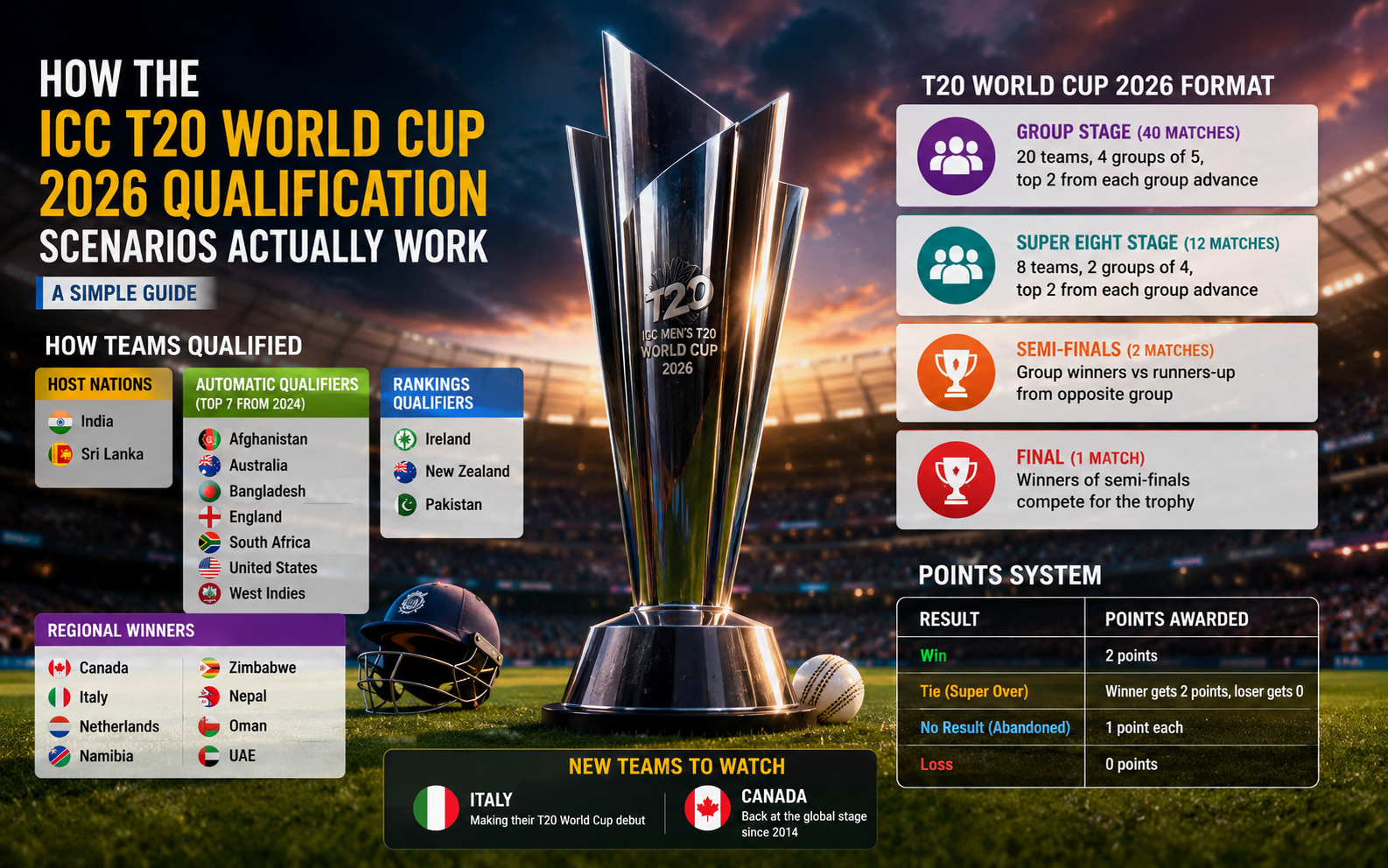
The next group of teams qualified based on their performance. They earned spots at the 2024 T20 World Cup. The top seven finishers from that tournament qualified automatically. These teams are Afghanistan, Australia, Bangladesh, England, South Africa, the United States, and the West Indies.
Three more teams qualified through the ICC T20 rankings. Pakistan, Ireland, and New Zealand secured their berths this way. The cut-off for rankings was based on performances leading up to the tournament.
Regional Qualification Pathways and Italy Debut
The remaining eight spots went to teams that won their regional qualifying tournaments. The ICC scrapped the old global qualifier system and moved to an entirely regional qualification process. Each of the five ICC development regions held their own qualifying tournaments.
From the Americas, Canada qualified. From Europe, Italy and the Netherlands made it through. Italy’s qualification was dramatic. They beat the Netherlands in a tense final match of the Europe Regional Qualifier to pip Jersey to a spot. They will make their T20 World Cup debut in 2026. From Africa, Namibia and Zimbabwe qualified. From the Asia/East Asia-Pacific region, Nepal, Oman, and the UAE secured the final three spots.
Scotland, Uganda, and Papua New Guinea played in the 2024 World Cup but failed to qualify this time. Bangladesh originally qualified but pulled out after the ICC refused their request to play matches in Sri Lanka instead of India. Scotland replaced them.
| Host Nations | Automatic Qualifiers (Top 7 from 2024) | Rankings Qualifiers | Regional Winners |
| India | Afghanistan | Ireland | Canada |
| Sri Lanka | Australia | New Zealand | Italy |
| Bangladesh | Pakistan | Netherlands | |
| England | Namibia | ||
| South Africa | Zimbabwe | ||
| United States | Nepal | ||
| West Indies | Oman | ||
| UAE |
Breakdown of the T20 World Cup 2026 Format
First Round Group Stage Mechanics
The tournament has three phases. First is the group stage. The 20 teams are split into four groups of five. Each team plays the other four teams in their group once. That means every team plays four matches in the first round.
The top two teams from each group advance to the next stage. The bottom three teams are eliminated. The group stage has 40 matches in total.
Super Eight Stage Qualification Rules
The eight teams that survive the group stage move to the Super Eight stage. This is the second round. The eight teams are split into two groups of four. The seeding is preset based on ICC rankings before the tournament, not on group stage finishing positions.
Group 1 features India, Australia, West Indies, and South Africa. Group 2 features England, New Zealand, Pakistan, and Sri Lanka. Each team plays the other three teams in their Super Eight group once. The top two teams from each Super Eight group advance to the knockout stage.
Knockout Stage Semifinals and Final
The knockout stage is simple. Two semi-finals and a final. The winners of each Super Eight group face the runners-up from the opposite group in the semi-finals. The semi-finals are on March 4 and 5. The final is on March 8 at the Narendra Modi Stadium in Ahmedabad.
- Group Stage (40 matches): 20 teams, 4 groups of 5, top 2 from each group advance
- Super Eight Stage (12 matches): 8 teams, 2 groups of 4, top 2 from each group advance
- Semi-Finals (2 matches): Group winners vs runners-up from opposite group
- Final (1 match): Winners of semi-finals compete for the trophy
Navigating the T20 World Cup 2026 Points Table Rules
Win Points and Abandoned Match Rules
The points system is straightforward. A team gets 2 points for a win. They get 1 point for a no result. They get 0 points for a loss. There are no ties in T20 cricket. The Super Over rule decides the winner. At the end of the group stage and the Super Eight stage, the teams with the most points qualify. But when teams finish level on points, the standings are decided by Net Run Rate.
Net Run Rate and Tiebreaker Scenarios
Net Run Rate is the main way to break ties in cricket tournaments. It shows how much a team dominates their opponents. For example, if a team scores 6 runs per over on average but gives away 5 runs per over, their Net Run Rate is plus 1. It is a simple way to measure overall performance.
If teams are still tied after Net Run Rate. Then the head-to-head record is considered. After that, the number of wins is taken into account. Then other tie-breakers are applied. Because Net Run Rate can change dramatically based on how big a win or loss is, even small differences can have a major impact on qualification.
| Result | Points Awarded |
| Win | 2 points |
| Tie (Super Over) | Winner gets 2 points, loser gets 0 |
| No Result (Abandoned) | 1 point each |
| Loss | 0 points |
Strengths Weaknesses Opportunities and Threats for New Teams
Assessing Core Strengths and Inherent Weaknesses
New teams like Italy and Canada bring fresh energy to the tournament. Italy’s squad includes players with international experience, like Wayne Madsen who was capped 19 times by South Africa. They also have the element of surprise. Opponents have less footage and data on these teams.
But the weaknesses are clear. These teams lack depth and experience. They do not have the same domestic structure. They lack high-performance facilities. The gap in quality is big between associate nations and full members. Italy and Canada will face strong bowling attacks. They will face powerful batting lineups. These are much stronger than anything they have seen in regional qualifiers.
Evaluating Growth Opportunities and Tournament Threats
The opportunity is massive. World Cup gives these teams global exposure. Players get to compete against the best in the world. The experience alone can accelerate their development. The ICC has been investing in associate nations, and this tournament is proof of that growth.
The threats are equally real. Top-tier bowling attacks can destroy inexperienced batting lineups. The pressure of playing in front of huge crowds in India and Sri Lanka can be overwhelming. Italy are in Group C alongside England, which is a daunting prospect. But they have already proven they can compete. They stunned Scotland by 12 runs in the European qualifier. That win was decisive in sealing their qualification.
Final Verdict on the T20 World Cup 2026 Qualification
The 2026 T20 World Cup is the most inclusive one yet. Twenty teams from all over the world will take part. The qualification process gave every ICC member a pathway to the tournament. Hosts India and Sri Lanka got automatic spots. The top teams from the 2024 World Cup qualified through performance. Teams like Pakistan, Ireland, and New Zealand earned their spots through rankings. And eight teams fought through regional qualifiers to earn their place.
Italy’s debut is the highlight of the expansion. They came through a nerve-shredding European qualifier and will now face the best in the world. Canada are back at a global tournament for the first time since 2014. The format is fair and balanced. Four groups of five, a Super Eight stage, and a knockout round. Fifty-five matches in total, culminating in the final at Ahmedabad on March 8.
The tournament shows that cricket is growing. The regional qualification pathways have helped bring cricket to more countries. The 2026 World Cup is not just about who lifts the trophy. It is about how the game is reaching every corner of the world.
Want to stay ahead with expert cricket insights, ICC tournament updates, player analysis, and match guides? Follow Online Cricket ID for fresh, in-depth cricket articles and the latest news delivered every day.
