


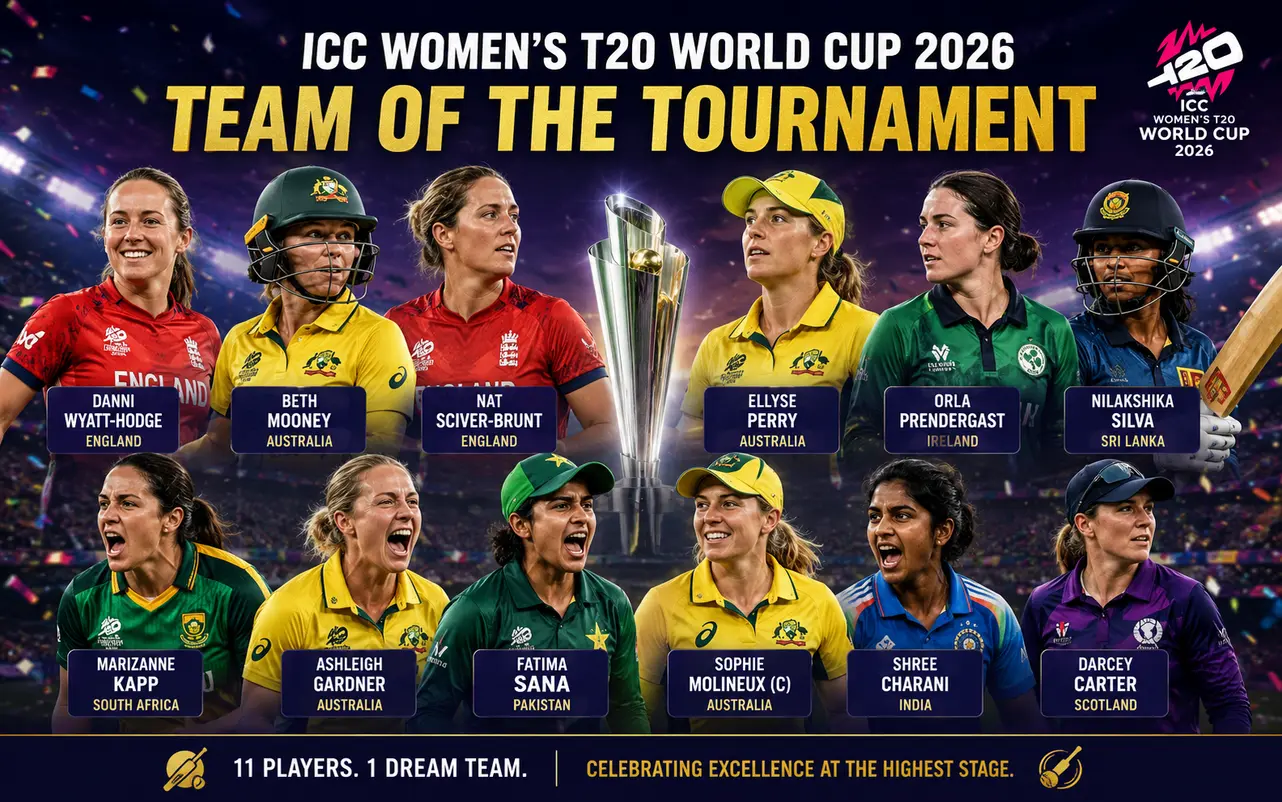
The ICC announces a Team of the Tournament after every major World Cup. It is not about one final performance. It is about consistent impact across the whole tournament. The 2026 Women’s T20 World Cup Team of the Tournament was announced on July 6. Australia won the title for the seventh time. They beat England by seven wickets in the final at Lord’s. Four Australians made the official XI. India had only one player selected. That player was Shree Charani, the tournament’s leading wicket-taker. Here is the full list of players who made the team and why they were chosen.
Who Made The Official Women’s T20 World Cup 2026 XI
Which Players Were Selected In The Tournament XI
The ICC announced the official XI in batting order. Danni Wyatt-Hodge (England) and Beth Mooney (Australia) opened the batting. Nat Sciver-Brunt (England) batted at number three. Ellyse Perry (Australia) was at number four. Orla Prendergast (Ireland) was at number five. Nilakshika Silva (Sri Lanka) was at number six. Marizanne Kapp (South Africa) was at number seven.

Ashleigh Gardner (Australia) was at number eight. Fatima Sana (Pakistan) was at number nine. Sophie Molineux (Australia) was the captain and the lead spinner. Shree Charani (India) was the strike bowler. Darcey Carter (Scotland) was named the 12th player. This was the first time a Scottish cricketer made a Women’s T20 World Cup Team of the Tournament.
Why Did Australia Have Four Players In The Final XI
Australia won all seven of their matches. They were the best team in the tournament. Their players dominated the statistics. Beth Mooney was the Player of the Tournament. Sophie Molineux was the captain and the second-highest wicket-taker. Ellyse Perry was named Player of the Match three times. Ashleigh Gardner scored runs at a strike rate above 170 and took wickets. Australia’s four selections reflect their unbeaten run and the individual brilliance of their players.
| Player | Country | Role | Key Contribution |
| Danni Wyatt-Hodge | England | Opener | 302 runs, tournament top scorer |
| Beth Mooney | Australia | Opener / Wicketkeeper | 238 runs, Player of the Tournament |
| Nat Sciver-Brunt | England | Middle order | 227 runs in 4 matches, average 113.50 |
| Ellyse Perry | Australia | All-rounder | 198 runs, 4 wickets, 3 Player of the Match awards |
| Orla Prendergast | Ireland | All-rounder | 181 runs, 6 wickets |
| Nilakshika Silva | Sri Lanka | Middle order | 148 runs at average 74 |
| Marizanne Kapp | South Africa | All-rounder | 124 runs, 8 wickets |
| Ashleigh Gardner | Australia | All-rounder | 150 runs at SR 170.45, 3 wickets |
| Fatima Sana | Pakistan | All-rounder / Captain | 11 wickets, 85 runs |
| Sophie Molineux | Australia | Captain / Spinner | 11 wickets, tournament joint-second highest |
| Shree Charani | India | Spinner | 14 wickets, tournament leading wicket-taker |
| Darcey Carter | Scotland | 12th player | First Scot in Team of the Tournament |
Why Did Beth Mooney Become The Batting Heart Of The XI
How Did Beth Mooney’s Runs Shape Australia’s Title Run
Beth Mooney scored 238 runs in seven matches. Her average was 47.60. Her strike rate was 142.51. She hit three half-centuries. She scored 64 off 49 balls in the final. She scored 61 not out in the semi-final. Her runs gave Australia stability at the top of the order. She set the platform for every chase. She anchored the innings while others played freely around her.
Why Was Mooney So Valuable In The Knockout Matches
Mooney performed when it mattered most. She scored half-centuries in both the semi-final and the final. This was the third time she scored a half-century in a T20 World Cup final. She was named Player of the Tournament for the second time. She was also named Player of the Match in the final. She is the first women’s player to win both awards twice. Her composure under pressure made her the batting heart of this XI.
How Did Sophie Molineux Lead The Best XI And Australia
What Made Molineux A Smart Choice As Tournament Captain
Sophie Molineux was appointed Australia’s captain at the start of 2026. She had injury problems before the tournament. She missed games early in her captaincy. But she led Australia to a seventh title in her first tournament as captain. She made smart bowling changes. She kept the team calm under pressure. She marshalled her troops with aplomb. The ICC selected her as captain of the Team of the Tournament.
How Did Her Spin Create Control In Key Overs
Molineux finished as Australia’s leading wicket-taker. She took 11 wickets in seven matches. She often struck early in her spell. Her left-arm spin created control in the middle overs. She bowled with economy and took wickets. She was joint-second in the wicket-taking charts for the tournament. Her bowling and leadership made her an easy choice to captain this XI.
Which All Rounders Made The Tournament XI Stronger
Why Did Ashleigh Gardner And Marizanne Kapp Stand Out
Ashleigh Gardner scored 150 runs at a strike rate of 170.45. She also took three wickets. She played match-winning knocks against India and the West Indies. Marizanne Kapp scored 124 runs and took eight wickets. Her unbeaten 81 against India propelled South Africa into the semi-finals. Her new-ball spells regularly broke through opposition top orders. Both players offered tactical flexibility and delivered under pressure.
How Did Fatima Sana And Orla Prendergast Represent Emerging Teams
Fatima Sana led Pakistan with both bat and ball. She took 11 wickets at an average of 11.27. She scored an unbeaten 55 and took 3 for 16 against South Africa. Orla Prendergast scored 181 runs and took six wickets. She scored 63 and took 1 for 29 against the West Indies. She then scored 59 and took 2 for 26 against New Zealand. Her performances helped Ireland secure their first-ever World Cup win. Both players gave their nations greater visibility on the global stage.
Which Batters Earned Their Place Through Consistency
Why Did Danni Wyatt Hodge Lead The Tournament Batting Story
Danni Wyatt-Hodge finished as the tournament’s top run-scorer. She scored 302 runs in seven matches at an average of 60.40. Her strike rate was 149.50. She hit an unbeaten century against Sri Lanka. She also scored two more half-centuries. She is the first batter to score more than 300 runs in a single Women’s T20 World Cup. Her consistency at the top of England’s order earned her a place in this XI.
How Did Sciver Brunt Perry And Silva Add Middle Order Class
Nat Sciver-Brunt played only four matches. She still scored 227 runs at an average of 113.50. She hit four consecutive scores over 40. She top-scored for England in the semi-final and the final. Ellyse Perry scored 198 runs and took four wickets. She was named Player of the Match three times. Nilakshika Silva scored 148 runs at an average of 74. She scored an unbeaten 54 to guide Sri Lanka to victory over defending champions New Zealand. Each player brought class, experience, and match-winning ability to the middle order.
Which Bowlers Changed Matches When Pressure Was Highest
Why Did Shree Charani Become India’s Lone Selection
Shree Charani finished as the tournament’s leading wicket-taker. She took 14 wickets in just five matches. This is the second-highest tally ever recorded at a single Women’s T20 World Cup. She took at least two wickets in every match she played. Her best figures were 4 for 19 against the Netherlands. She also took 3 for 21 against Pakistan and 3 for 24 against South Africa. India exited in the group stage. But Charani’s performances were exceptional. She broke the record for most wickets by an Indian in a single T20 World Cup edition. She was India’s lone selection.
How Did Pace And Spin Create A Balanced Bowling Attack
The bowling attack in this XI has everything. Fatima Sana provides new-ball pace. Marizanne Kapp offers control and wickets with the new ball. Sophie Molineux and Shree Charani are left-arm spinners who can control the middle overs. Ashleigh Gardner provides off-spin variety. This attack can take wickets in the powerplay, control the middle overs, and execute at the death. It is a complete T20 bowling unit.
What Does This Team Of The Tournament Say About Women’s Cricket Now
How Did The XI Show The Growing Depth Of Global Women’s Cricket
This XI has players from eight different nations. Australia, England, South Africa, India, Pakistan, Ireland, Sri Lanka, and Scotland are all represented. Ireland and Sri Lanka have players in the team for the first time. Scotland have a player as the 12th woman. This shows the competition is getting stronger. It is no longer just about Australia and England. Teams like Ireland, Pakistan, and Sri Lanka are producing world-class players.
Which Players Could Carry This Form Into The Next Cycle
Some players are still young. Shree Charani is 21 years old. Orla Prendergast is a rising star. Darcey Carter is the first Scottish player to make a Team of the Tournament. They can carry this form into future World Cups. Beth Mooney, Ellyse Perry, and Sophie Molineux will lead Australia for years. Danni Wyatt-Hodge and Nat Sciver-Brunt will continue to anchor England’s batting. The future of women’s T20 cricket is bright.
Conclusion
The ICC Women’s T20 World Cup 2026 Team of the Tournament recognises the best performers across the competition. Australia’s champions dominate the XI with four players. Beth Mooney was the Player of the Tournament. Sophie Molineux was the captain and a leading wicket-taker. Ellyse Perry won three Player of the Match awards.
Ashleigh Gardner contributed with both bat and ball. Shree Charani was the tournament’s leading wicket-taker and India’s only representative. The team also includes players from England, South Africa, Pakistan, Ireland, Sri Lanka, and Scotland. This shows the growing depth of global women’s cricket. The future is bright. And this XI is proof.
Stay ahead of every match with expert cricket analysis, match previews, player insights, and tournament updates. Follow Online Cricket ID for the latest cricket articles, breaking news, and daily coverage from around the world.
