


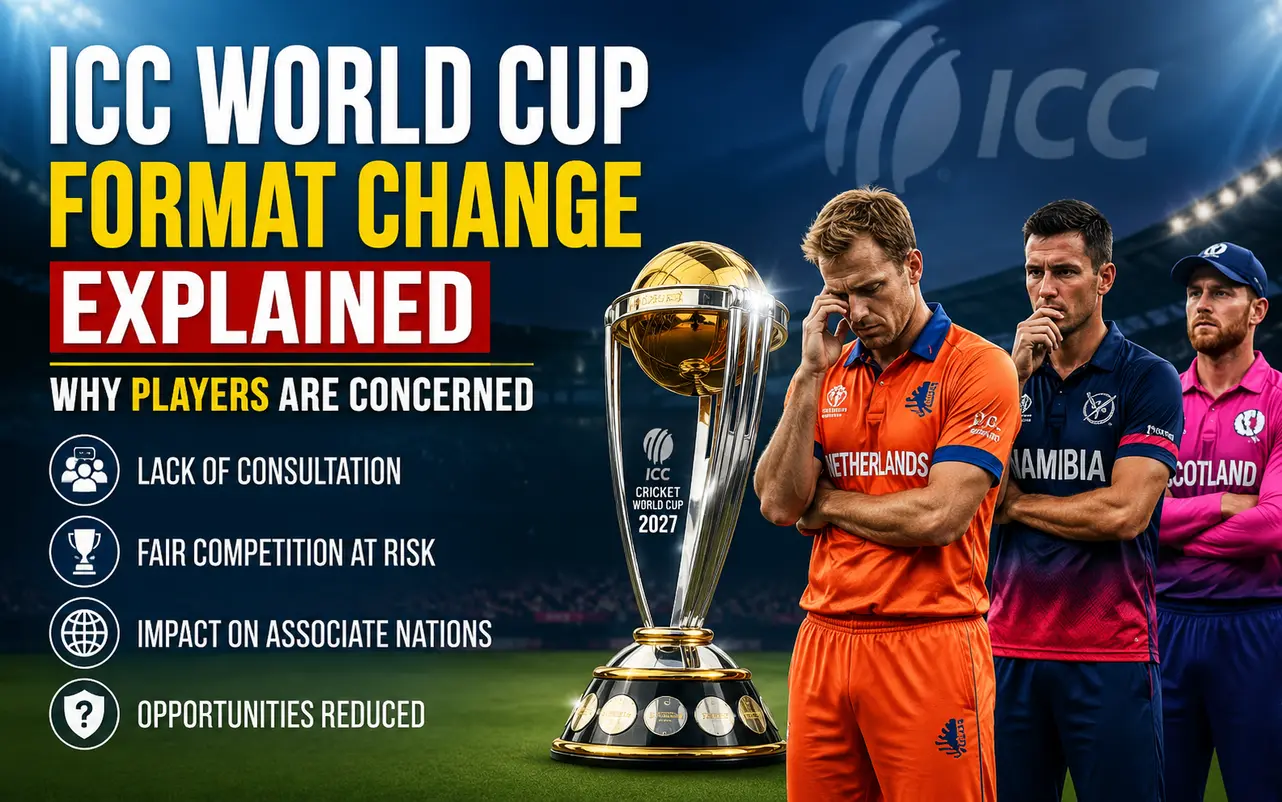
The ICC has changed the format of the 2027 ODI World Cup. The tournament still has 14 teams, like they promised back in 2021. But the path to the final is now very different. The new format has a “Super Series” round that eliminates two teams after just two matches. The World Cricketers’ Association (WCA), which represents over 700 international players, has raised serious concerns. Players from associate nations have called the decision “incredibly disappointing”. The ICC says the changes will make the tournament more competitive. But players and their union argue the move reduces opportunities for emerging cricket nations and was made without proper consultation.
What Is Changing In The ICC World Cup Format
The ICC announced the changes at their Annual Conference in Edinburgh in July 2026. The previous format had two groups of seven teams, followed by a Super Six stage, then the semi-finals and final. That structure was announced back in 2021, and teams had planned their qualification campaigns around it. The new format is completely different.

How Will The New World Cup Structure Work
The 2027 World Cup is being co-hosted by South Africa, Zimbabwe and Namibia. The tournament runs from October 4 to November 21. Here is how the new format works, step by step.
Round 1: The Super Series
The three lowest-ranked qualifying teams, ranked 12, 13 and 14, play a round-robin stage. Only the winner of this Super Series advances to the next round. The other two teams are eliminated after playing just two matches each.
Round 2: The Group Stage
12 teams are split into two groups of six. Each team plays the other five teams in their group once. That is 30 matches in total.
Round 3: The Super 7 Stage
The top three teams from each group qualify for the Super 7, along with the next best team across both groups. That makes seven teams. They play each other once in a round-robin format. That is 21 matches.
Knockouts
The top four teams from the Super 7 go to the semi-finals. The semi-finals are 1 vs 4 and 2 vs 3. The winners meet in the final.
Why Is The ICC Changing The Tournament Now
The ICC says the new format is designed to “strengthen the competitive narrative across every stage of the event”. They want to reduce dead rubbers, where matches do not matter because teams have already qualified. They also want to ensure higher stakes are attached to every match. The ICC said the changes would “enhance the overall experience for fans while continuing to provide emerging teams with the opportunity to compete on cricket’s biggest stage”. The final structure and exact fixtures will be confirmed at an ICC meeting in September 2026.
Why Are Players Concerned About The New Plan
The reaction from players has been fierce. The World Cricketers’ Association has raised concerns across four key areas: transparency, consultation, global growth, and impact
Do Players Believe The Format Reduces Fair Competition
The WCA argues that the revised format “falls short of the opportunity presented by expansion to 14 teams”. For some countries, qualification no longer guarantees a genuine World Cup campaign or the chance to compete against established nations.
Netherlands captain Scott Edwards said, “Qualifying for an ODI World Cup is a huge achievement for any country, so when the reality of that opportunity changes after years of planning, it’s incredibly disappointing”. Namibia captain Gerhard Erasmus said, “For players in many countries, an ODI World Cup isn’t just another tournament. It’s our long form and something careers are built around”.
Has The World Cricketers Association Been Heard
The WCA says the ICC failed to meaningfully consult players before announcing the changes. WCA CEO Tom Moffat said, “When commitments are made to the game, qualification pathways are established and countries and players invest years pursuing those opportunities, significant changes deserve genuine consultation, transparency and a clear explanation”.
Scotland captain Richie Berrington echoed this: “Players don’t expect to make every decision, but we should be meaningfully consulted on decisions that have significant impacts on the game and on players’ careers”. The WCA also pointed out that major cricket boards like those of India, Pakistan and Sri Lanka do not recognise the association.
Could Associate Nations Lose Their World Cup Opportunity
This is the biggest concern. The new format means that two of the three lowest-ranked qualifiers will play only two matches at the World Cup and then go home. Associate nations have spent years battling through regional competitions, the Cricket World Cup League 2, and the World Cup Qualifier just to reach the tournament.
Why Does Qualification Access Matter So Much
Oman captain Vinayak Shukla explained it clearly: “The World Cup is the most prestigious tournament for any associate nation, as we don’t play any red-ball cricket. So the World Cup is the only opportunity we get to play against the full members; otherwise, we don’t get any chances to play them”. Former Oman skipper Jatinder Singh added, “For us, the epitome of the game is playing the World Cup. If that becomes a bit hard to play, then it becomes a lot more difficult for the players to rub shoulders with the greats”.
Can Smaller Teams Still Create A World Cup Surprise
Players like Scott Edwards worry that the new format makes it harder for associate teams to create the kind of upsets that make the World Cup special. “The ICC talks a lot about growing the game globally, but decisions like this make it harder for Associate nations to play against the best teams in the world,” Edwards said.
Namibia captain Gerhard Erasmus said, “We all accept that you have to earn the right to be there, but we also want qualifications to provide a real opportunity to compete on the biggest stage. This follows a long history of limited opportunity at the Associate level”. Ireland captain Paul Stirling pointed to football’s expanding 48-team FIFA World Cup as an example cricket should follow.
How Does The Super Series Change The Tournament
What Is The Super Series In Simple Terms
The Super Series is a new preliminary round. The three lowest-ranked qualifying teams play each other. Only the winner moves on. The other two teams are out after two matches. As WCA CEO Tom Moffat put it, “For some countries, qualification will no longer guarantee a genuine World Cup campaign or the opportunity to compete against established nations”.
Do Early Results Become Too Important In The Super Series
Yes. With only three teams and two matches each, every ball matters. A single bad over can end a team’s World Cup dream. The ICC says this creates “higher consequence”. But players argue it creates unfair pressure on the teams that have already fought hardest just to qualify.
Will The New Format Create More Meaningful Matches
Can The Format Reduce Dead Rubber Matches
The ICC’s main argument is that the new format will reduce dead rubbers. It will make every match count. Only 12 teams will be in the group stage. Only seven of them will advance to the Super 7. There is less room for error. The Super 7 stage will have seven teams fighting for four semi-final spots. This should create high-stakes cricket.
Will Fans Find The New Path Easier To Follow
This is less clear. The new format has three stages: Super Series, group stage, and Super 7. The previous format had two stages. The ICC believes the new structure will be “more compelling”. But critics argue that eliminating two teams before the tournament properly begins makes the competition smaller and less interesting.
How Could The New Format Affect Player Workload
Does More Context Also Mean More Pressure On Players
The ICC says the new format creates “higher consequence” for every match. That means more pressure on players from the very first game. For associate players, the pressure is even greater. Their World Cup could be over after just two matches. Oman captain Vinayak Shukla said, “It undermines the efforts of the associate nations and the emerging nations that have been working hard over the past few years”.
Can The ICC Protect Players Without Weakening The Event
The WCA argues that the ICC must do better. “Across global sport, the long-term trend has been towards broader participation, stronger stakeholder engagement and greater certainty including around major events,” Moffat said. He added, “Realising those opportunities requires greater transparency, modern leadership and meaningful collaboration and engagement between all stakeholders”.
What Must The ICC Clarify Before 2027
Which Qualification Rules Still Need Clear Answers
The ICC’s release did not clarify whether the qualification process itself has changed. The 14-team tournament has 10 automatic qualifiers: the two Full Members among the three co-hosts and the top eight ranked teams. The remaining spots are filled through the World Cup Qualifier. But the WCA has asked whether the Super Series effectively acts as an extra qualifier within the tournament itself.
Can The ICC Win Back Trust Through Transparency
The WCA has called for “clear communication, transparent decision-making and sufficient certainty for players and stakeholders who have planned around previously announced ICC commitments”. Tom Moffat said, “This isn’t simply about the format of one tournament. It’s about ensuring game wide confidence in how the game makes major strategic decisions”. The ICC has not yet responded to these concerns.
Conclusion
The 2027 ODI World Cup format change is a major decision with far-reaching consequences. The ICC says it will create more meaningful matches and a more competitive tournament. Players and the WCA argue it reduces opportunities for emerging nations and was made without proper consultation. The tournament still has 14 teams, but two of them will play only two matches before going home.
For associate nations, the World Cup is their only chance to compete against full members. Taking that opportunity away, or making it harder, goes against the ICC’s stated goal of growing the game globally. The next few months will be crucial. The ICC must clarify the qualification rules. They must consult with players. They must address the concerns raised by the WCA. If they do not, the 2027 World Cup could be remembered for the controversy. It might not be remembered for the cricket.
Want more in-depth cricket analysis, breaking news, and exclusive updates? Follow Online Cricket ID and stay ahead with the latest cricket articles, match insights, and tournament coverage every day.
